
Upzoning legally expands what you can build on a parcel — more units, taller structures, smaller minimum lot sizes — and that expanded permission gets priced into land almost immediately. Parcel-level research in Chicago found transaction prices rising 15%–23.3% on affected lots after upzoning, before a single new unit was permitted. For homeowners and developers planning ADUs or small modern homes, understanding that mechanism is the difference between acting at the right moment and leaving value on the table.
Table of Contents
- What does upzoning actually change about your zoning code?
- How does upzoning affect property values? What the research shows
- How upzoning shifts your property’s “highest and best use”
- What upzoning means specifically for your ADU or small home project
- Why legal permission to build doesn’t mean construction will happen
- How to assess whether upzoning benefits your specific lot
- What comes next: timeline and cost buckets for an ADU build
- Gentrification, displacement, and the equity side of upzoning
- Key Takeaways
- A note on how Live Large™ reads the zoning map for you
- Live Large™ takes your project from zoning map to finished unit
- Useful sources
What does upzoning actually change about your zoning code?
Upzoning modifies zoning laws to allow higher-density development: multi-family housing in formerly single-family zones, taller buildings, reduced minimum lot sizes, and lower parking requirements. The practical effect is that your parcel can legally support more square footage, more units, or both.
A few terms worth knowing before you read your local ordinance:
- Floor area ratio (FAR): Total buildable floor area divided by lot area. A FAR of 1.5 on a 5,000 sq ft lot means 7,500 sq ft of building is permitted.
- Density: Maximum dwelling units per acre or per lot.
- Minimum lot size: The smallest parcel allowed for a given use. Reductions here enable lot splits.
- Height limit: Maximum building height, often expressed in stories or feet.
- ADU (accessory dwelling unit): A secondary, self-contained unit on a single-family or small multifamily lot.
- Lot split: Dividing one parcel into two or more separately titled lots.
- Entitlements: The approved development rights attached to a specific parcel.
Code changes that signal an upzoning relevant to ADU and small-home projects include: allowance of duplexes or triplexes by right in R-1 zones, increased FAR, reduced side and rear setbacks, elimination of owner-occupancy requirements for ADUs, reduced or eliminated parking minimums, and explicit ADU-by-right provisions.
Pro Tip: Start with your city or county’s online zoning map (search “[city name] GIS zoning map”), then cross-reference the municipal code on Municode.com. Look for the most recent ordinance amendment date — that tells you whether a reform is recent enough to affect your project.
How does upzoning affect property values? What the research shows
The most consistent finding across parcel-level studies is rapid capitalization: the market prices in new development rights quickly, often before construction begins. The Chicago difference-in-differences study put that uplift at 15%–23.3% on affected parcels. A Nashville study covering 2000–2023 found a significant average price increase on upzoned parcels relative to comparable untreated ones, with the largest gains concentrated at the lower end of the price distribution.
The gains are not evenly distributed. Underdeveloped parcels capture the greatest uplift because they carry the most redevelopment option value. A vacant lot or a single-story house on a large lot in an upzoned area gains far more than a parcel already built to its maximum footprint.
| Finding | Source | Key Statistic |
|---|---|---|
| Chicago parcel-level upzoning | Freemark (2019) | +15%–23.3% transaction price increase on affected parcels |
| Auckland upzoning (most intensive zone) | Greenaway-McGrevy et al. | notable premium for near-vacant parcels; less for fully developed ones |
| NYC long-run effects | SAGE Journals (2024) | Increases in housing units and prices, with demographic shifts in intensely upzoned areas |
| Short-term construction response | Freemark (2019) | Little evidence of new building permits in first years despite strong price effects |
Long-run construction outcomes are more mixed: modest upzonings often produce modest supply increases over time, but the timing and scale depend heavily on local market demand and the scope of the reform.
How upzoning shifts your property’s “highest and best use”
When zoning changes, appraisers are required to reconsider a parcel’s highest and best use — the legally permitted, physically possible, financially feasible, and maximally productive use of a site. Upzoning shifts that lens from a single-family comparables approach to a redevelopment-value approach for many parcels.
Practically, that means:
- Land value vs. structure value: The land component grows relative to the structure, especially on underdeveloped lots.
- Development-option value: Appraisers may factor in the option to demolish and rebuild at higher density.
- Comparable sales set: Comps shift from nearby single-family sales to land sales or income-producing properties.
- Tax assessment: Assessors can re-evaluate using the new permitted density, which may raise your assessed value and property taxes before you break ground.
Pro Tip: Before refinancing or selling after a rezoning, request a pre-listing appraisal from an appraiser who specializes in land and development properties. A standard residential appraiser may undervalue the redevelopment premium your lot now carries. See how ADU resale impact plays out in practice.
What upzoning means specifically for your ADU or small home project
Upzoning can make an ADU project easier, more valuable, or newly possible — but it does not automatically update ADU-specific rules. Your city may upzone a neighborhood to allow duplexes while keeping a separate ADU ordinance with its own setback, size, and owner-occupancy requirements. Check both layers.
Before moving forward, verify:
- Permitted unit types: Does the new zone allow ADUs by right, or only with a conditional use permit?
- Maximum unit count: Can you now add a junior ADU plus a detached ADU on the same lot?
- Setback and height changes: Rear setbacks for ADUs often differ from the base zone setbacks.
- Lot coverage: Total impervious or built area as a percentage of lot size may cap your ADU footprint.
- Parking requirements: Many upzoning reforms reduce or eliminate ADU parking minimums near transit.
- Permit review process: By-right permits are faster and cheaper than discretionary approvals.
On the financial side, upzoning can improve your multifamily ADU development economics in two ways: the underlying land value increases, which strengthens a cash-out refinance or sale, and lenders may offer better terms when the zoning supports a higher-value use. The flip side is a potential property tax increase if your assessor re-rates the parcel under the new highest and best use.
Pro Tip: If the zoning change is recent, a quick call to your city’s planning counter (most offer free pre-application meetings) will confirm whether your lot qualifies under the new rules before you spend money on design.
Why legal permission to build doesn’t mean construction will happen
Upzoning increases the option value of land. Actual construction is a separate decision, driven by whether the numbers work.
Researchers consistently find that upzoning reduces legal constraints but does not guarantee a supply response. Actual building depends on market demand, parcel potential, financing availability, and the scale of the reform.
The Chicago data makes this concrete: strong price capitalization appeared quickly, but building permits showed little increase in the first years after the reform. Value moves first. Construction follows when the development math clears.
The filters that determine whether building actually happens on a given parcel:
- Market demand: Is there rental or resale demand for the additional units at a price that covers costs?
- Development cost vs. revenue: Construction costs, soft costs, and financing must leave a viable margin.
- Parcel size and shape: Odd lots, easements, and setback constraints can make a theoretically upzoned parcel unbuildable in practice.
- Infrastructure capacity: Sewer, water, and electrical capacity must support additional units.
- Entitlement complexity: Discretionary approvals add time and cost that can kill marginal projects.
For high-demand rental markets, the pipeline typically moves: value capitalizes within months, permits follow in one to three years, and construction completes one to two years after that. In softer markets, the option value sits dormant.
How to assess whether upzoning benefits your specific lot
The short answer: run a five-step check before committing to design or financing.
- Pull your current zoning and any pending amendments from the city GIS map and confirm the effective date of any recent change.
- Verify ADU-specific rules in the municipal code separately from the base zone — unit count, size caps, setbacks, owner-occupancy, and permit type.
- Calculate residual FAR: Subtract your existing built floor area from the maximum permitted under the new zoning. A large residual means significant development potential remains.
- Check infrastructure and easements: Call the utility provider and review your title for easements that could constrain placement of a new structure.
- Get a feasibility sketch or pre-application meeting: A 30-minute session with a planner or architect costs little and confirms whether your lot is physically and legally viable before you spend on full design.
Key questions to bring to that meeting:
- What is the maximum unit count and FAR now permitted on my parcel?
- Are ADUs allowed by right, or does this require a conditional use permit?
- What setbacks apply to a detached ADU specifically?
- Has the assessor re-rated similar parcels in this zone since the rezoning?
- Are there inclusionary requirements or affordable-unit set-asides triggered at a certain unit count?
- What is the typical permit timeline for a by-right ADU here?
- Are there any infrastructure capacity constraints flagged for this block?
The ADU vs. house addition comparison is worth running at this stage too — upzoning sometimes makes a new detached unit more valuable than expanding the existing structure.
What comes next: timeline and cost buckets for an ADU build
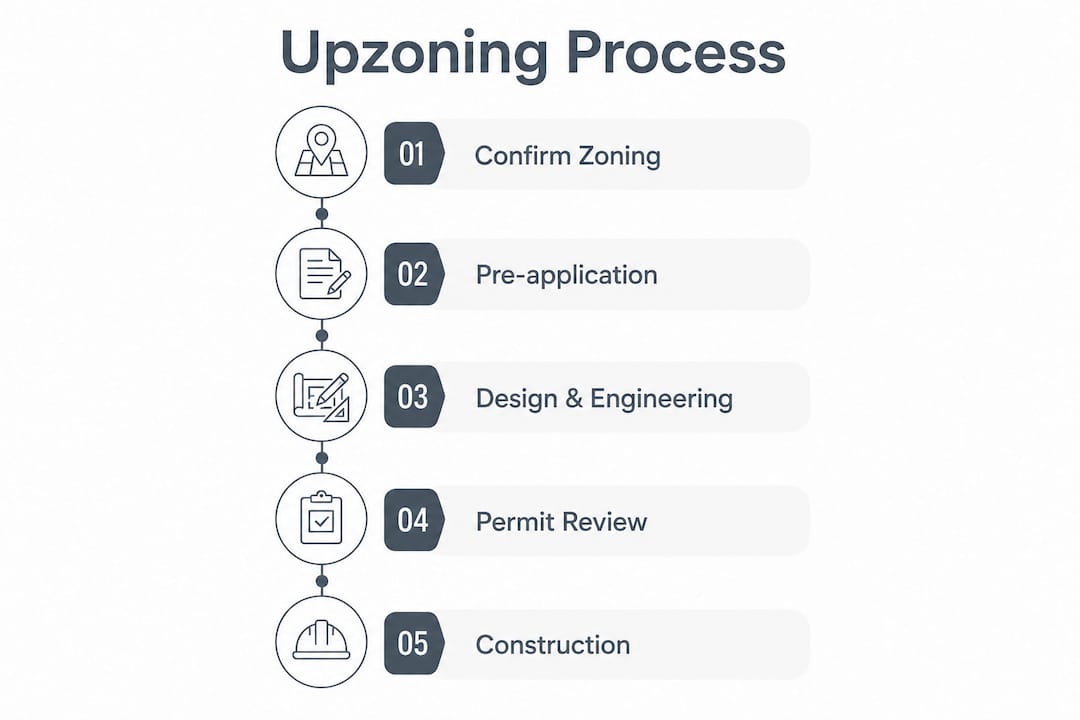
Once you confirm upzoning works in your favor, the path to a finished ADU or small home runs through five phases.

Verify and entitle (1–4 months): Confirm zoning, submit a pre-application, and secure any required approvals. By-right projects move fastest here.
Design and engineering (2–4 months): Architectural drawings, structural engineering, and MEP (mechanical, electrical, plumbing) design. Panelized or prefab approaches can compress this phase.
Permit review (1–6 months): Varies widely by jurisdiction. Cities with over-the-counter ADU permits can approve in days; others take months.
Construction (3–9 months): Depends on unit size, site conditions, and delivery method. A detached 400 sq ft ADU builds faster than a 1,200 sq ft small home.
Cost buckets to budget: site prep and demolition, foundation and structure, MEP rough-in and finish, interior finish and fixtures, and soft costs (design fees, permits, utility connections). Soft costs alone often run 15%–20% of hard construction costs on small projects.
Pro Tip: Lock in your construction financing before finalizing design. ADU-specific loan products — including renovation loans and HELOCs — have different draw structures than ground-up construction loans. Knowing your financing ceiling early prevents costly redesigns. The real costs of building an ADU are worth reviewing before you finalize a budget.
Gentrification, displacement, and the equity side of upzoning
Modest upzonings that enable ADUs or small increases in unit count carry far lower displacement risk than sweeping, area-wide increases in FAR and height. The NYC research makes the distinction clear.
Intense upzonings in New York City were associated with larger increases in large multifamily buildings, greater rent appreciation, and measurable demographic shifts toward higher-income, more-educated, and non-Hispanic white populations — effects that were substantially weaker in moderately upzoned areas.
That pattern from NYC neighborhood-level data does not mean all upzoning causes displacement. Scale and intensity matter. An ADU ordinance that adds one or two units per lot across a neighborhood produces a very different outcome than a rezoning that allows 12-story buildings on formerly single-family blocks.
Communities and municipalities use several tools to manage these risks alongside upzoning: inclusionary zoning requirements (a percentage of new units priced below market), tenant protection ordinances, affordable housing set-asides triggered at certain unit counts, and incentives tied to green building or affordability that shift project feasibility calculations. If your city is running a public comment process on a proposed upzoning, showing up with specific questions about these tools is the most productive form of participation.
Key Takeaways
Upzoning changes a parcel’s legal development ceiling immediately, but value capture, permitting, and construction follow on different timelines — and underdeveloped lots benefit most.
| Point | Details |
|---|---|
| Value moves before construction | Chicago research shows 15%–23.3% price increases on upzoned parcels before new permits appear. |
| Underdeveloped lots gain most | Parcels with significant residual FAR capture the largest redevelopment premium after a zoning change. |
| ADU rules are a separate check | Upzoning the base zone does not automatically update ADU-specific setback, size, or permit rules. |
| Intense upzoning carries equity risk | NYC data links large-scale FAR increases to gentrification signals; modest ADU-scale changes show far weaker effects. |
| Live Large™ covers the full path | Live Large™ handles feasibility, entitlement support, and construction for ADUs and small modern homes. |
A note on how Live Large™ reads the zoning map for you
Live Large™ tracks municipal zoning changes across markets including Tampa ADU policy reforms and Pasco County ADU approvals as they happen. That ongoing monitoring means the team can tell you quickly whether a recent ordinance change affects your specific parcel and whether an ADU or small modern home is now viable where it was not before. If you are at the “should I even look into this?” stage, that first conversation is the right place to start.
Live Large™ takes your project from zoning map to finished unit
Most homeowners and developers lose months figuring out whether their lot qualifies, which permits to pull, and how to finance a build that pencils out. Live Large™ shortens that path. The team handles feasibility analysis, entitlement support, design coordination, and full construction and installation of ADUs and small modern homes — so you are not piecing together a contractor, a planner, and a lender separately.
If upzoning has opened a window on your property, the next step is a feasibility check. Visit the Live Large™ homeowner page to start the conversation, or review the 2026 urban infill planning guide to see how small-home development works in practice before you commit.
Useful sources
- Freemark, Y. (2019). Upzoning Chicago: Impacts of a Zoning Reform on Property Values and Housing Construction. The primary parcel-level study quantifying the 15%–23.3% price effect and the lag in permit activity.
- Freemark, Y. (2023). Zoning Change: Upzonings, Downzonings, and Their Impacts. Framework review covering construction outcomes, affordability, and incentive packages across multiple markets.
- SAGE Journals (2024). Upzoning and gentrification: Heterogeneous impacts of neighbourhood-level upzoning in New York City. NYC long-run data on housing supply, price appreciation, and demographic shifts by upzoning intensity.
- Urban Institute. Zoning Change. Policy review summarizing mixed short-term and modestly positive long-term construction evidence across U.S. markets.
- Brookings Institution. The double-edged sword of upzoning. Accessible explainer on the trade-offs between density gains and displacement risk.
- McKissock Learning. Upzoning: What It Is and What Appraisers Need to Know. Industry-focused overview of how appraisers handle highest-and-best-use shifts after rezoning.
- SAGE Journals. Heterogeneous impacts of zoning change on parcel values. Research on how redevelopment option value distributes unevenly across parcels with different development intensity.
- Your local municipal code: Search “[city or county name] municipal code” on Municode.com, then navigate to the zoning or land development chapter. The ADU ordinance is typically a subsection of the residential zoning article. Check the amendment history for any changes in the past 24 months.