
Seattle now allows up to two accessory dwelling units per lot by right, with no owner-occupancy requirement, under the consolidated standards in SMC 23.42.022 (Ordinance 127211). Each unit maxes out at 1,000 square feet, and neither can be rented short-term. The governing code lives in that ordinance, and every permit path runs through ADUniverse and the Seattle Department of Construction and Inspections (SDCI).
TL;DR:
- Seattle allows up to two ADUs per lot without owner-occupancy or parking requirements, with each unit capped at 1,000 square feet.
- Detached ADUs can reach 32 feet in height in many zones, but must sit on a fixed foundation, not a tiny house on wheels.
- Permit approval typically takes a few weeks if using pre-approved plans, but delays often occur from incomplete submissions or overlooked costs like the sewer capacity charge.
- Adding an ADU will likely increase property taxes proportionally to the unit’s size and value, which can be offset by rental income if the unit is leased long-term.
- Short-term rentals are prohibited, but ADUs can be rented long-term under standard landlord-tenant laws, with rental income being taxable.
Table of Contents
- What Are the Current Seattle ADU Rules?
- Which Seattle Lots and Zones Qualify for an ADU?
- How Big Can a Seattle ADU Be, and What Are the Setback Rules?
- What Permits and Fees Should You Budget For?
- How Do You Apply for an ADU Permit in Seattle?
- What Mistakes Delay or Inflate the Cost of Seattle ADU Projects?
- Do ADUs Change Your Property Taxes in Seattle?
- What Rules Apply to Renting Out a Seattle ADU?
- Where to Find Official Seattle ADU Resources
- When Does a Turnkey Build Make More Sense Than Going It Alone?
- Ready to Build an ADU on Your Seattle Lot?
- Sources
What Are the Current Seattle ADU Rules?
Before you sketch a floor plan, run through this checklist to see if your project clears the basics.
- Unit count: up to two ADUs per lot by right, whether attached (AADU), detached (DADU), or one of each.
- Size cap: 1,000 square feet of gross floor area per unit, with a narrow exception for converting existing structures.
- Height: detached units can reach up to 32 feet in many Neighborhood Residential zones.
- Parking: you don’t need to add parking for a new ADU, but you can’t remove required off-street spaces to make room for one.
- Occupancy: no owner-occupancy requirement anywhere in the city.
- Rentals: ADUs cannot operate as short-term rentals under current city rule summaries.
- Verification: confirm your specific lot against SMC 23.42.022, ADUniverse, and SDCI’s permit pages before you commit to a design.
Which Seattle Lots and Zones Qualify for an ADU?
Seattle allows ADUs anywhere a single-family dwelling is permitted, which covers most residential land in the city. That includes the Neighborhood Residential zones (NR1, NR2, NR3) and Residential Small Lot (RSL) designations that replaced the old single-family zoning map.
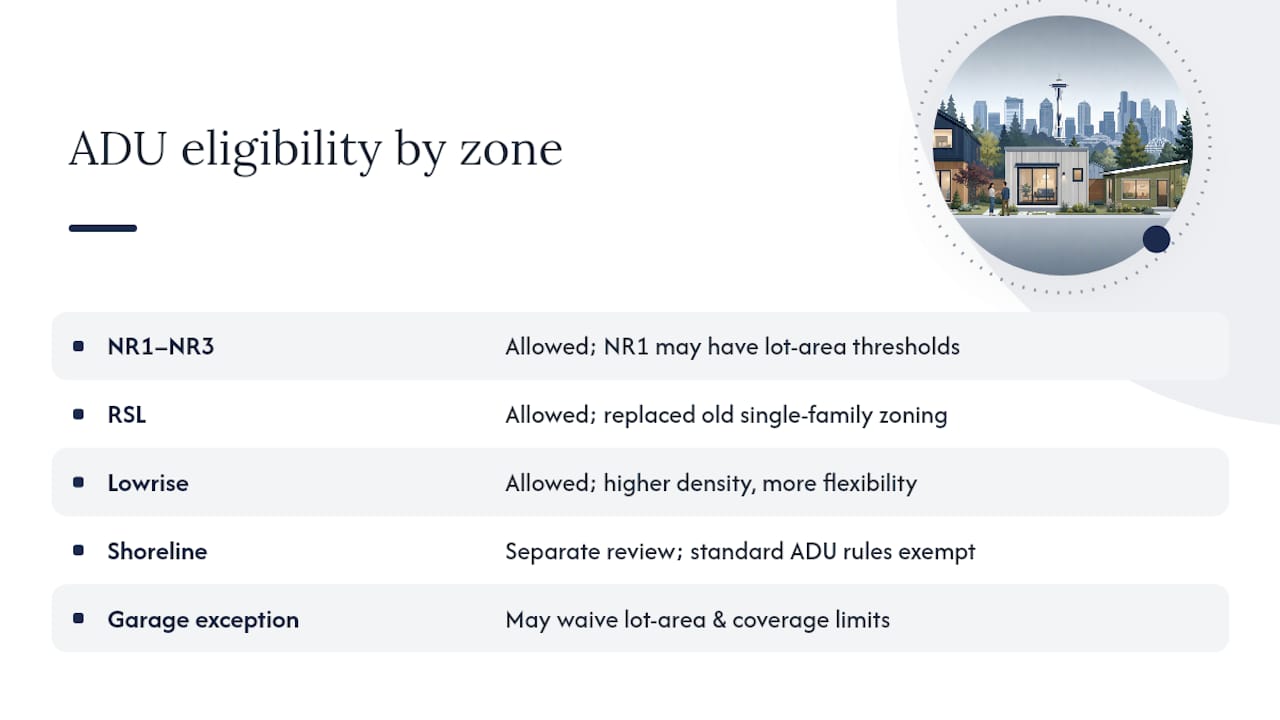
Some Neighborhood Residential zones still carry minimum lot-area thresholds that affect how many units and how much floor area you can build, particularly in NR1 areas designed around larger lots. Lowrise zones handle density differently, generally with more flexibility since they already permit higher unit counts. If you’re converting an existing garage or accessory structure into a DADU, you may qualify for exceptions to some lot-area and coverage rules, a point covered in SDCI Tip #116B. Shoreline districts fall outside standard ADU rules and require separate review. If your lot sits near a shoreline or environmentally critical area, check with SDCI before assuming standard limits apply. For a deeper look at how lot size interacts with these thresholds, see our breakdown of minimum lot size requirements for ADUs.
How Big Can a Seattle ADU Be, and What Are the Setback Rules?
The 1,000 square foot gross floor area cap applies per unit across every residential zone in the city, a figure the city set to standardize what used to be a patchwork of zone-specific limits. Detached ADUs in many Neighborhood Residential zones can reach 32 feet in height, though building separation rules between your main house and the DADU still apply, along with floor-area-ratio and lot coverage limits set in Chapter 23.44.
Measure carefully here. This is one of the most common places projects get tripped up in plan review.
Parking rules are simpler than most homeowners expect: the city won’t make you add parking spaces for a new ADU, but you can’t eliminate spaces the code already requires for your main house. One more thing worth flagging: a tiny house on wheels doesn’t count as a permanent DADU. Detached units must sit on a fixed foundation to qualify.
What Permits and Fees Should You Budget For?
Adding or legalizing an ADU requires a construction addition or alteration permit through SDCI, plus separate electrical and plumbing permits if your project touches those systems. SDCI’s guidance confirms your unit has to meet residential, building, mechanical, electrical, energy, land use, and environmentally critical areas code, all at once.
Timeline depends heavily on which route you take:
- Pre-approved DADU plans through ADUniverse: typically permit review takes a few weeks for pre-approved DADU plans through ADUniverse.
- Custom-designed units: expect a longer cycle through intake, plan corrections, full review, inspections, and final sign-off.
Pro Tip: Upload complete PDFs, not partial packets, when you submit through the Seattle Services Portal. Missing energy calculations or an unclear site plan is the single fastest way to get bounced back into corrections.
Budget beyond the city fee schedule, too. King County assesses a separate sewer capacity charge that catches a lot of homeowners off guard because it doesn’t show up on SDCI’s permit fee list. Add utility service changes through Seattle City Light, and your total permitting cost climbs well past what the base permit fee suggests. Our cost breakdown for a 600 square foot ADU walks through where that money actually goes.
How Do You Apply for an ADU Permit in Seattle?
- Confirm zoning and lot eligibility. Check your zone designation and any minimum lot-area thresholds before you spend money on design.
- Choose your route. Decide between converting an existing structure, designing a custom unit, or using a pre-approved plan through ADUniverse.
- Use ADUniverse if speed matters. The pre-approved DADU designs skip a chunk of the plan-review cycle because the city has already vetted the design against code.
- Assemble your documents. You’ll need a site plan, floor plans, energy calculations, and structural plans if you’re doing new construction, all uploaded digitally through the Seattle Services Portal.
- Respond to corrections quickly. Most delays come from slow turnaround on reviewer comments, not the comments themselves.
- Schedule inspections and close out. Final occupancy approval follows your last inspection sign-off.
If your lot has slope issues, an environmentally critical area overlay, or you want permitting and financing handled as one package, that’s usually the point where hiring a design-build turnkey provider saves more time than it costs.
What Mistakes Delay or Inflate the Cost of Seattle ADU Projects?
Most permit delays trace back to a handful of repeat mistakes, not bad luck.
- Forgetting the King County sewer capacity charge. It’s assessed separately from your city permit fees and catches homeowners who only budgeted against SDCI’s fee schedule.
- Assuming a tiny house on wheels qualifies. It doesn’t. A DADU needs a permanent foundation, full stop.
- Removing required parking to make room for a new unit. You can skip adding parking, but you can’t eliminate what your main house already needs.
- Misapplying rear-yard coverage math on a conversion. The extra 20% allowance only applies in specific circumstances, not automatically.
- Submitting incomplete digital packets. Missing energy calculations or a vague site plan is the fastest route to a corrections cycle.
Pro Tip: If your project touches an unusual lot configuration or an older accessory structure, request a pre-submittal review or a formal code interpretation before you finalize drawings. It’s a small delay upfront that avoids a much bigger one later.
Do ADUs Change Your Property Taxes in Seattle?
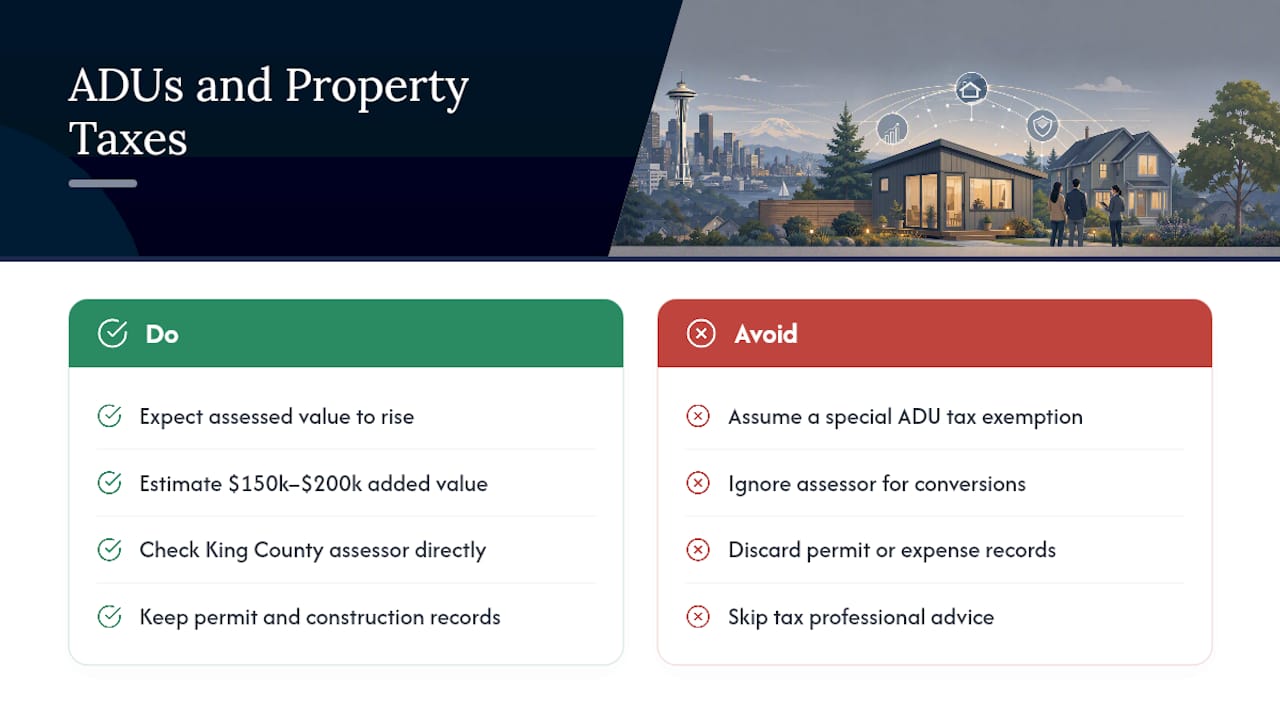
Adding an ADU almost always increases your property’s assessed value, since King County’s assessor factors in the added square footage and any increase in market value the unit creates. That translates into a higher property tax bill, though the increase is generally proportional to the ADU’s size and finish level rather than a flat penalty.
Washington state doesn’t offer a dedicated ADU tax exemption the way some states have experimented with. What homeowners sometimes overlook is that the tax hit is often offset, at least partially, by the rental income the unit generates once it’s occupied. A 1,000 square foot DADU that adds $150,000 to $200,000 in assessed value will raise your annual tax bill, but the math typically still favors the homeowner if the unit is rented at market rate for more than a year or two.
One detail worth checking with King County directly: if you’re converting an existing garage or structure rather than building new, the assessed value increase may be smaller than a ground-up build, since you’re adding living space rather than new square footage on the parcel. Keep records of your permit costs and construction expenses. They matter later if you ever sell the property, since capital improvements can affect your cost basis and any capital gains calculation. This isn’t a substitute for advice from a tax professional or the King County Assessor’s office, but it’s the framework most homeowners need to plan around.
What Rules Apply to Renting Out a Seattle ADU?
The single biggest restriction to know: your ADU cannot operate as a short-term rental. That rule exists specifically to keep these units in the long-term housing supply rather than competing with hotels, and it applies regardless of whether you built an AADU or a DADU.
Beyond that, Seattle doesn’t impose ADU-specific lease-term rules or tenant qualification standards. Renting out your ADU puts you under the same Washington landlord-tenant law framework that governs any other rental unit in the state, covering security deposits, notice periods, and eviction procedures. Treat your ADU tenant with the same lease structure and screening process you’d use for any rental property, because legally, that’s exactly what it is.
Rental income from an ADU counts as taxable income and needs to be reported on your federal tax return, typically on Schedule E if you’re not living in the main house, or handled slightly differently if you occupy the primary residence and rent the accessory unit. If you’re converting an existing structure that wasn’t previously permitted as living space, get it legalized before you start collecting rent. An unpermitted rental carries real risk if a dispute ever ends up in front of a judge, and it can also complicate a future sale, a risk worth understanding before it becomes a disclosure problem at closing.
Where to Find Official Seattle ADU Resources
Skip the secondhand summaries when you’re ready to verify a specific rule and go straight to these:
- SMC 23.42.022 / Ordinance 127211: the actual code text and policy summary behind the 2025 consolidation.
- SDCI’s ADU permit page: permit types, required codes, and application steps.
- ADUniverse: the pre-approved DADU plan gallery and submission guide.
- SDCI Tip #116B: technical guidance on egress, heating, and conversion exceptions.
- Seattle Services Portal: where you’ll actually upload documents and track your application.
When Does a Turnkey Build Make More Sense Than Going It Alone?
Complex lots, older structures you want to convert, or financing that needs to move alongside permitting are exactly where a bundled design-build approach earns its keep. A feasibility review upfront tells you what your lot actually supports before you spend money on drawings that don’t fit the zone. That’s the step Live Large™ recommends starting with.
— Rudy
Ready to Build an ADU on Your Seattle Lot?
A turnkey provider can manage the whole process as one package: permitting, design, financing assistance, and construction, instead of you managing separate contractors, a permit expediter, and a lender on three different timelines.
That matters most for homeowners juggling a full-time job who don’t have weeks to spend tracking down corrections letters or chasing subcontractor schedules. The turnkey ADU development model bundles the pieces that usually create the most delay when handled separately, and the prefabrication process can shorten your build timeline once permits clear. Start with a feasibility review through Live Large™’s turnkey ADU services to find out what your lot supports and what it will actually cost to build.
Sources
- ADUs and Middle Housing – Building Connections
- Accessory Dwelling Unit – Construction and Inspections
- ADUniverse
- SDCI Tip #116B – Establishing a Detached Accessory Dwelling Unit (DADU)
- ADU rules in Seattle, WA — CityRuleLookup