
A passive income ADU structure is defined as a legally permitted accessory dwelling unit on your property that generates rental revenue with minimal ongoing effort from you as the owner. The industry term is “accessory dwelling unit,” or ADU. These are self-contained living spaces with a kitchen, bathroom, and sleeping area on the same lot as your primary home. Homeowners and real estate investors across the U.S. are turning to ADUs as one of the most direct passive income strategies available, combining property value growth with monthly cash flow. Live Large™ works with homeowners at every stage of this process, from design to financing to installation.
What is a passive income ADU structure and which type earns the most?
ADU structures fall into four main categories, and the type you build directly shapes your rental income potential, upfront cost, and return timeline.
- Detached ADU: A freestanding unit in your backyard. It offers the most privacy and commands the highest rents. Detached ADUs rent for 70–85% of the per square foot rate of the main home and typically range from 400–800 sq ft. That privacy premium makes them the top choice for investors focused on rental income.
- Attached ADU: A unit connected to the main home, sharing at least one wall. Construction costs are lower than a detached build, but tenants pay slightly less due to reduced privacy.
- Garage conversion ADU: An existing garage transformed into a living unit. This is a cost-efficient path because the structure already exists. Permitting and finishing costs vary widely by city.
- Basement conversion ADU: The lowest cost entry point. Basement ADUs work well in markets where above-grade space is expensive, though natural light and egress requirements add cost.
Initial construction costs range from $150 to $600 per square foot depending on ADU type, location, and finish level. That wide range reflects the difference between a basic basement conversion and a fully custom detached backyard home.
Pro Tip: Match your ADU type to your neighborhood’s rental demand before you break ground. A detached unit in a high-demand urban market will outperform a basement conversion in a suburban area with low renter density.

How does an ADU structure generate passive income and increase property value?
The financial case for building an ADU rests on two separate income streams: monthly rent and long-term property appreciation.
On the rental side, ADU investment opportunities in high-demand markets are significant. In Los Angeles, for example, ADU projects yield $2,000 to $4,000 monthly rent with an 8–12% annual ROI when combining rental income and appreciation. Break-even typically falls in the 5–10 year range depending on financing and location. Those figures represent a strong return compared to most passive income strategies available to individual homeowners.
On the appreciation side, homes with permitted ADUs can see property value increases of 20–35%, with some markets recouping 100–120% of construction costs on sale. That means a well-built ADU can pay for itself entirely when you sell, on top of the rental income it generated while you owned the property.
Calculating your real return
Gross rental income is not your actual return. Cash-on-cash return is the right metric. It accounts for financing costs, operating expenses, vacancy, and maintenance. Net yields run about 10–20% lower than gross figures once those costs are factored in. That gap matters when you are deciding whether to finance construction with a HELOC or pay cash.
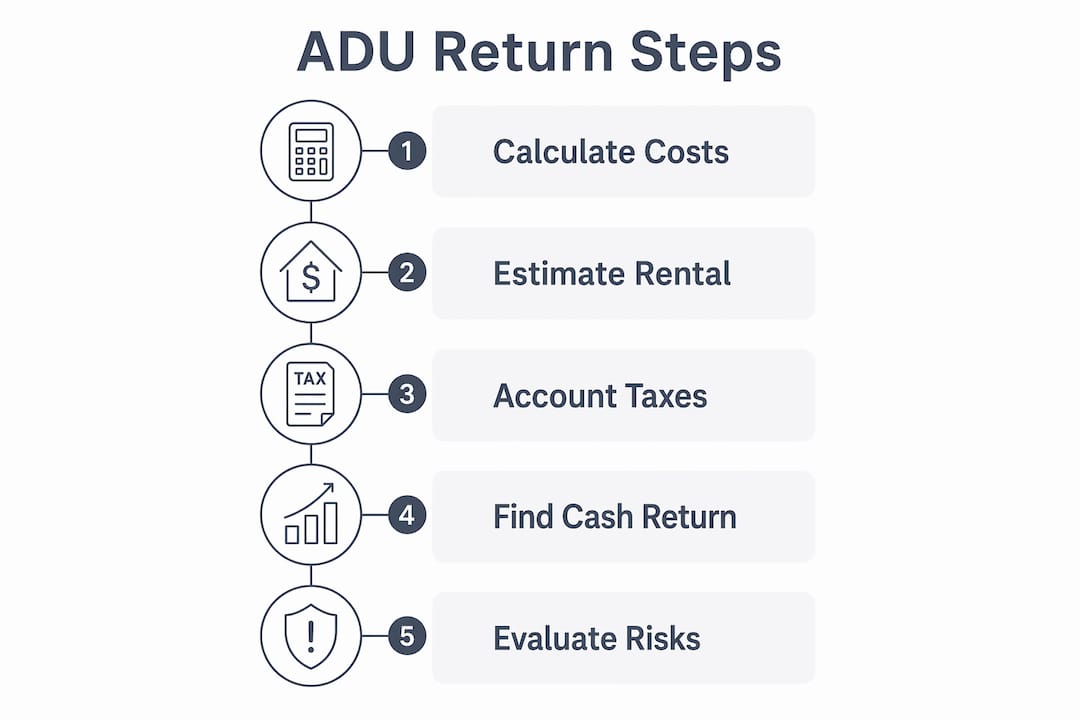
Tax advantages add another layer to the financial picture. ADU owners can deduct mortgage interest, depreciation, repairs, and property management fees against rental income. Cost segregation studies allow investors to accelerate depreciation on components like appliances, flooring, and fixtures, generating larger deductions in the early years of ownership.
Pro Tip: Use a HELOC payment calculator before committing to construction financing. Knowing your monthly debt service lets you calculate true cash-on-cash return before you spend a dollar.
What are the legal, zoning, and regulatory factors that affect ADU rental income?
Regulatory compliance is the single biggest variable in ADU investment outcomes. A unit built without proper permits cannot be legally rented, which eliminates the income stream entirely and creates liability.
Zoning regulations including setbacks, parking, and utility fees often cause construction delays of 6–12 months or project infeasibility, even in states with favorable ADU laws. State-level ADU allowances do not override local municipal rules. Your city or county may impose:
- Minimum lot size requirements before an ADU is permitted
- Setback rules that limit where on your lot the unit can be placed
- Parking replacement mandates if you convert a garage
- Owner-occupancy requirements that restrict renting both units simultaneously
- Short-term rental ordinances that ban platforms like Airbnb in residential zones
Local zoning nuances such as setback requirements and parking mandates critically affect ADU feasibility despite favorable statewide laws. Failure to anticipate these results in costly delays or outright cancellations. A feasibility study before you design or permit is not optional. It is the first step.
Florida is an active example of regulatory evolution. Tampa has reformed its ADU policy to make permitting more accessible for homeowners, and Pasco County has approved ADU development in areas where it was previously restricted. These changes reflect a national trend toward loosening ADU restrictions to address housing supply.
Pro Tip: Pull your local zoning code and confirm setback, height, and parking rules before hiring an architect. Discovering a deal-breaking restriction after you have paid for plans is an expensive mistake.
How to structure ADU rentals for tax efficiency and less landlord work
The IRS does not automatically classify ADU rental income as passive. The classification depends on your rental model and how much time you spend managing the property.
Under standard IRS rules, ADU rental income is classified as passive unless the owner materially participates or qualifies for the short-term rental (STR) loophole. Passive losses can only offset other passive income. That limits their usefulness for W-2 earners who want to reduce their tax bill.
The STR loophole changes that equation. Short-term rental income requires average stays under 7 days and material participation for losses to be classified as non-passive by the IRS. When those conditions are met, STR losses can offset W-2 income directly. For a homeowner in a high tax bracket, this is a meaningful benefit.
Here is how to structure your ADU rental for the best combination of tax efficiency and minimal active involvement:
- Long-term rental (12+ month lease): Generates stable, predictable income. Classified as passive by the IRS. Best for owners who want low involvement and are not seeking to offset W-2 income.
- Mid-term rental (1–6 months): Popular with traveling nurses, contractors, and remote workers. Slightly higher rents than long-term. Still typically classified as passive.
- Short-term rental (under 7 days average stay): Highest gross income potential. Qualifies for the STR loophole if you materially participate. Requires more active management or a professional co-host.
Property management automation and professional services help reduce active landlord involvement, turning ADU rentals into more genuinely passive income sources. Automated rent collection, digital lease signing, and maintenance request platforms reduce your weekly time commitment significantly. Hidden landlord costs including maintenance, utilities, and tenant turnover can erode net yields by 10–20% if you do not budget for them upfront.
ADUs function as hybrid investment assets combining residential features with commercial-like returns when managed with net operating income (NOI) and capitalization rate modeling. Treating your ADU like a small commercial asset, rather than a casual side income, is what separates investors who hit their return targets from those who do not.
Key takeaways
A permitted ADU structure is the most direct path for U.S. homeowners to generate passive income from real estate while simultaneously increasing property value by 20–35%.
| Point | Details |
|---|---|
| ADU type determines income | Detached ADUs command the highest rents; basement conversions offer the lowest build cost. |
| Permitted ADUs add property value | Homes with permitted ADUs can see value increases of 20–35% and may recoup 100–120% of build costs on sale. |
| Tax classification matters | Long-term rentals are passive by default; the STR loophole lets short-term rental losses offset W-2 income. |
| Zoning is the biggest risk | Local setbacks, parking rules, and rental ordinances can block an ADU project even where state law allows it. |
| Net yield beats gross income | Cash-on-cash return runs 10–20% below gross rental figures once financing, vacancy, and maintenance are counted. |
The passive income myth I keep correcting
People come to ADU investing expecting a mailbox money situation. You build the unit, rent it out, and the checks arrive. That picture is not wrong, but it is incomplete in ways that cost investors real money.
The “passive” label is accurate for tax purposes under the right structure. It is not accurate as a description of the work involved, at least not in the first year. Permitting, contractor management, furnishing, and tenant onboarding require real time and attention. I have seen homeowners underestimate this phase and burn out before the income ever stabilizes.
The investors who do best treat the ADU like a small business during setup and a passive asset during operation. They hire a property manager, automate rent collection, and build a maintenance reserve from day one. The hidden costs including turnover, repairs, and vacancy are real. Budget 10–20% of gross rent for operating expenses and you will not be surprised.
The other thing I consistently see overlooked is the tax structure decision. Choosing long-term versus short-term rental is not just a lifestyle preference. It determines whether your losses are useful on your tax return. If you are a W-2 earner with significant income, the STR loophole can be worth more than the rent itself in the first year. Talk to a CPA who specializes in real estate before you sign your first lease.
ADUs are genuinely one of the best passive income strategies available to homeowners today. They combine income, appreciation, and tax benefits in a single asset. Just go in with clear eyes about what “passive” actually means in practice.
— Rudy
How Live Large™ helps you build passive income with an ADU
Live Large™ specializes in the purchase, financing, development, construction, and installation of accessory dwelling units and small footprint modern homes. If you are ready to turn your backyard into a passive income property, the team at Live Large™ covers every step from feasibility to move-in day.
Florida homeowners have a real window right now. Recent ADU policy reforms in Tampa and expanding approvals across the state are making it faster and less expensive to permit and build. Live Large™ tracks these regulatory changes so you do not have to. Whether you are evaluating your first ADU or planning a multi-unit investment, Live Large™ provides the financing tools, design expertise, and construction support to get your unit built and rented.
FAQ
What is a passive income ADU structure?
A passive income ADU structure is a permitted accessory dwelling unit on your property that generates rental revenue with limited ongoing involvement from the owner. It includes a kitchen, bathroom, and sleeping area and is legally recognized as a separate dwelling.
How much rental income can an ADU generate?
ADU rental income varies by market and unit type. In Los Angeles, ADUs yield $2,000 to $4,000 per month, with annual ROI of 8–12% combining rent and appreciation.
Does ADU rental income count as passive income for taxes?
Long-term ADU rentals are classified as passive income by the IRS by default. Short-term rentals with average stays under 7 days and material participation qualify as non-passive, allowing losses to offset W-2 income.
What are the biggest risks in ADU investing?
Local zoning restrictions including setbacks, parking mandates, and short-term rental ordinances are the primary risks. These can delay or block a project even in states with favorable ADU laws.
How does an ADU increase property value?
Homes with permitted ADUs can see property value increases of 20–35%. In strong markets, sellers recoup 100–120% of construction costs, making the ADU a net-positive asset even before rental income is counted.