
If you’re searching for “devel homes” and trying to figure out whether a turnkey ADU or small modular home is worth the investment, the short answer is yes — with the right provider. Live Large™ (Small Lofts) is the recommended choice for U.S. homeowners and real estate investors who want a single team handling design, permits, construction, and installation without managing a dozen separate contractors.
Here’s what that means in practice:
- Request an estimate: Contact Live Large™ to get a project scope and preliminary cost range for your lot.
- Schedule a site assessment: Confirm your lot’s zoning, setbacks, and utility stub locations before signing anything.
- Check local zoning: Verify ADU allowances, lot coverage limits, and occupancy rules with your municipality — or let Live Large™ handle the research as part of the permitting package.
Table of Contents
- What does a turnkey devel homes package actually include?
- How much does a small modular ADU cost, and how do you finance it?
- What permitting and site prep do you need to sort out before buying?
- Why do homeowners and investors build ADUs and small modular homes?
- How does modular construction and installation actually work?
- How do you choose a turnkey ADU provider and spot red flags?
- Key Takeaways
- The turnkey path is the one most buyers underestimate
- Small Lofts by Live Large™: turnkey ADUs from design to move-in
- Useful sources and primary references
What does a turnkey devel homes package actually include?
A true turnkey package covers every phase from blank lot to move-in-ready unit. Knowing what each phase includes tells you exactly where cost and schedule risk can hide.
Design deliverables typically include a site plan, floor plan, structural drawings, and a finishes selection process. Some providers offer pre-approved design templates, which cut weeks off the permitting clock.
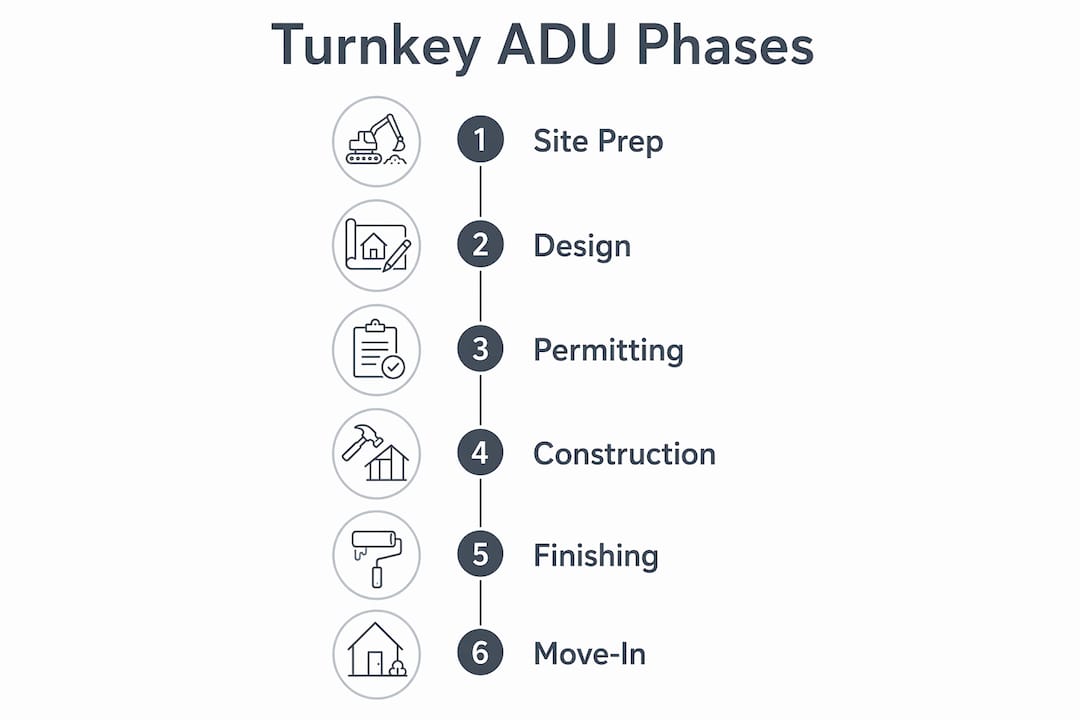
Permitting support means the provider researches local codes, prepares and submits the permit application, and coordinates inspections. This is where many self-managed projects stall. Permit timelines vary widely by jurisdiction — some municipalities turn around ADU permits in six to eight weeks; others take six months.
Construction and delivery covers the factory prefab or modular build, site foundation work, utility connections, and on-site installation. The ADU turnkey development model bundles all of this so no phase falls through the cracks between subcontractors.
Optional services include:
- HELOC financing assistance for homeowners who want to tap existing equity
- Investor capital placement and project structuring for multi-unit infill developments
- Property management and leasing coordination after installation
How much does a small modular ADU cost, and how do you finance it?
Cost is the first question every buyer asks, and the honest answer is that it depends on unit size, finish level, foundation type, utility connection complexity, and local labor rates. Expect costs to vary widely based on these factors, so use general ballpark figures cautiously when planning your budget.

Self-managing a large build can look attractive on paper. Project costs may vary widely depending on management approach, and while some report significant savings, the risks of delays, permit errors, and coordination failures can quickly offset those savings for less experienced homeowners.
Typical project timeline:
- Design and engineering: about one to two months
- Permit application and approval: varies significantly depending on jurisdiction, potentially several weeks to several months
- Factory build: often overlaps with permitting, typically several weeks
- Site prep and foundation: several weeks
- Delivery, crane set, and installation: ranging from a few days to a couple of weeks
- Finish trades and final inspections: several weeks
Financing routes worth modeling:
- HELOC: Homeowners with sufficient equity can draw against their primary residence. Use Live Large™’s HELOC payment calculator to model monthly payments against realistic draw amounts.
- Construction-to-permanent loans: One closing covers the build phase and converts to a standard mortgage at completion.
- Investor equity or project capital: For multi-unit infill, investors typically fund through project equity or private capital. Construction loan rates in 2026 have shifted meaningfully, so model conservatively.
Pro Tip: Pre-approved design templates and bundled permitting assistance are the two fastest ways to compress a project timeline. Providers who offer both can often shave 8–12 weeks off a typical schedule.
What permitting and site prep do you need to sort out before buying?
Permitting and site conditions are where most ADU projects hit unexpected delays. Surface these early.
Common zoning limits to check:
- Lot coverage maximums (often 40–50% of lot area)
- Setback requirements from property lines (rear and side)
- ADU size caps and height limits
- Owner-occupancy requirements (some jurisdictions require the primary homeowner to live on-site)
- Short-term rental restrictions if you plan to list on Airbnb
Check your local municipal zoning portal or call the planning department directly. Florida, for example, has seen active legislative momentum to expand ADU allowances statewide, which is shifting what’s possible in many counties.
Permitting steps and typical windows:
- Building permit application: submitted after design approval
- Utility permits (electrical, plumbing, gas): often separate applications
- Inspections: foundation, framing, rough-in trades, final occupancy
Houston’s Affordable Home Development Program targets buyers earning up to 120% of Area Median Income — a useful benchmark for understanding how municipal programs can affect project feasibility and financing eligibility in your market.
Site-prep checklist before you contract:
- Confirm grade and drainage (poor drainage = expensive foundation work)
- Verify crane and delivery truck access (minimum 10–12 ft clearance is typical)
- Locate existing utility stub-outs (water, sewer, electrical)
- Identify tree root zones, soil conditions, and easements
- Review any HOA restrictions that layer on top of municipal zoning
For investors evaluating raw lots, Live Large™’s land-sourcing guide covers lot selection and access requirements in detail.
Why do homeowners and investors build ADUs and small modular homes?
The financial case for ADUs has gotten stronger as housing costs have climbed. For homeowners, a backyard ADU generates rental income that can offset a mortgage payment, house an aging parent, or add resale value without a full addition. For investors, modular construction offers faster build cycles and lower per-unit costs compared with traditional stick-built projects.
Homeowner use cases:
- Backyard rental unit generating monthly income
- In-law or multigenerational suite with private entrance
- Short-term rental (where local rules allow)
- Home office or studio that converts to rental later
Investor use cases:
- Infill micro-developments on underutilized urban lots
- Scaled rental portfolios using repeatable modular designs
- Value-add plays on properties with ADU potential
The urban infill small home model is particularly compelling for investors because the same design can be deployed across multiple lots with minimal redesign cost.
A completed backyard ADU project in San Diego documented full renovation costs, a compressed timeline, and a quick post-completion sale — illustrating how a well-executed small-home project can generate both rental income and equity appreciation when the design and permitting phases are managed tightly from the start.
The real costs of building an ADU vary by market, but the income potential is consistent: a well-placed unit in most U.S. metros can generate $1,200–$2,500/month in rent.
How does modular construction and installation actually work?
Factory-built modular construction offers two advantages that matter most to buyers: quality control and schedule predictability. When walls are framed in a climate-controlled facility, there’s no weather delay and no material sitting exposed on a job site for weeks.
Step-by-step install process:
- Site prep: foundation poured, utility stubs positioned
- Factory build: modules constructed, inspected, and staged for transport
- Delivery: flatbed transport to site (transport constraints limit unit width, typically to 14–16 ft)
- Crane set: modules lifted and placed on foundation in a single day
- Finish trades: electrical, plumbing, HVAC connections, interior finishes
- Final inspections and certificate of occupancy
Customization limits are real. Modular designs offer meaningful choices in layout, finishes, and fixtures, but structural changes mid-production are expensive. Lock in your floor plan before the factory build starts.
The biggest risk in modular installation isn’t the crane day — it’s the two weeks before it. A foundation poured to the wrong dimension, a utility stub in the wrong location, or a blocked access path can push the entire schedule by weeks and add real cost.
What a solid warranty package looks like:
- Structural warranty: 10 years minimum on the modular frame
- Systems warranty: 1–2 years on mechanical, electrical, and plumbing
- Workmanship warranty: 1 year on finish trades
Pro Tip: Pre-order your final inspections before the crane day. Many jurisdictions allow you to schedule foundation and framing inspections in advance. Doing this cuts the post-install wait from weeks to days.
How do you choose a turnkey ADU provider and spot red flags?
Provider checklist:
- Scope clarity: does the contract specify who handles permits, inspections, and utility connections?
- Permit responsibility: is the provider the permit applicant of record, or are they handing that to you?
- Financing assistance: do they offer HELOC guidance or lender referrals?
- Timeline guarantees: are phase milestones written into the contract with consequences for delays?
- Warranty terms: are structural and systems warranties documented in writing?
- Sample contracts: will they share a redacted prior contract before you sign?
Red flags to walk away from:
- Vague permit language (“we’ll help with permits” without specifying who applies)
- No proof of completed installs with photos or references
- Fixed low bids submitted without a site visit
- No inspection coordination plan
- Unrealistic timelines (a full turnkey ADU in under 12 weeks is almost never realistic)
Match the provider to your priority. If passive income is the goal, prioritize providers with property management services. If speed matters most, look for pre-approved design libraries and established municipal relationships.
Key Takeaways
Turnkey ADU and small modular-home projects succeed when scope, permitting, financing, and site prep are locked in before construction starts — and Live Large™ covers all four.
| Point | Details |
|---|---|
| Verify zoning before contracting | Check lot coverage, setbacks, and ADU allowances with your municipality before signing anything. |
| — | Costs depend on unit size, finish level, foundation, utility complexity, and local labor rates. |
| Use a HELOC or construction loan | Homeowners with equity can model payments using Live Large™’s HELOC calculator before committing to a budget. |
| Confirm site readiness early | Foundation dimensions, utility stubs, and crane access must be confirmed before the factory build starts. |
| Live Large™ covers the full scope | Design, permits, construction, installation, and optional management — one provider, no coordination gaps. |
The turnkey path is the one most buyers underestimate
Most homeowners and investors who research ADU projects spend weeks comparing unit prices and floor plans before they’ve confirmed whether their lot can legally support one. That’s backwards. The permit and site assessment should happen first — before design, before financing, and certainly before any contract.
The turnkey model matters not because it’s cheaper (it usually isn’t, compared to a perfectly self-managed project), but because most buyers aren’t equipped to manage a project with six or eight separate contractors, a permit timeline they can’t control, and a factory build that won’t wait for a delayed foundation. Bundling those pieces under one provider doesn’t just save time. It eliminates the category of risk that kills most self-managed projects: the coordination failures that happen between contractors who each assume someone else is responsible.
Live Large™’s model addresses this directly. One contract, one point of accountability, and financing assistance built into the process rather than bolted on afterward.
Small Lofts by Live Large™: turnkey ADUs from design to move-in
Live Large™ (Small Lofts) handles every phase of your ADU or small modular-home project: design, permitting, factory construction, site installation, and optional property management for investors who want a fully passive income asset.
Homeowners get HELOC financing guidance and a clear project timeline from day one. Investors get a repeatable modular system built for small-home development scalability across multiple lots. The portfolio speaks for itself, and the permitting expertise means fewer surprises at the municipal counter.
Ready to see what your lot can support? Request an estimate or schedule a site assessment with Live Large™ today.
Useful sources and primary references
Use these primary sources to research local rules, financing ranges, and project examples relevant to your situation.
| Source | What It Covers | How to Use It |
|---|---|---|
| Houston AHDP | Municipal financing for homes affordable to buyers at or below 120% AMI | Check whether your project or buyer qualifies for city-backed financing programs |
| Construction Loan Rates 2026 | Rate ranges and financing math for 2026 construction projects | Model conservative payment scenarios before committing to a loan product |
| Live Large™ HELOC Calculator | Monthly payment modeling for HELOC-financed ADU projects | Estimate affordability before your site assessment |
| ADU vs. House Addition | Trade-off analysis for homeowners choosing between ADU and addition | Clarify which project type fits your lot, budget, and goals |
| Urban Infill Planning Guide | Investor-focused infill benefits and planning considerations | Evaluate lot potential and scalability before acquiring land |
- Local municipal zoning portal: Search “[your city] ADU zoning” to find setback rules, lot coverage limits, and permit applications specific to your jurisdiction.
- Florida ADU policy updates: State-level legislative changes are expanding what’s permissible in many Florida counties — worth checking if your property is there.
- Land sourcing for investors: Live Large™’s small-home land-sourcing guide covers lot selection, access requirements, and zoning pre-checks for infill development.