
Build-to-rent ADU tenant management is the practice of overseeing rental operations for both a primary residence and its accessory dwelling unit as a single coordinated asset. Most investors treat the two units separately, and that mistake creates double vacancy risk, maintenance conflicts, and missed tax deductions. The build-to-rent ADU model demands a unified operational approach: synchronized lease cycles, shared utility agreements, digital communication tools, and professional screening applied to both units. Mastering this process protects rental income, reduces turnover, and builds long-term property value.
What is build-to-rent ADU tenant management and why does it matter?
Build-to-rent ADU tenant management is defined as the coordinated oversight of a main house and an accessory dwelling unit operated together as a single rental investment. The industry term for this practice is unified rental asset management, and it applies directly to any investor running both units for income. Treating the units independently creates operational friction, vacancy gaps, and tenant disputes that erode returns. A unified approach eliminates those gaps by treating the property as one business.
The financial stakes are real. A 600–800 sq ft detached ADU in a high-demand coastal market rents for $2,000 to $3,500 monthly. That figure means a vacant ADU for even one month costs more than most investors expect. Coordinated lease management directly protects that income stream.

Build-to-rent ADU development also carries tax advantages that disappear without proper structure. Tax-smart management treats the ADU as a separate rental business, enabling depreciation deductions and better expense tracking. Owners who skip this step often miss $3,000 to $8,000 in annual deductions. That is not a rounding error. It is a structural failure in how the investment is managed.
What do you need before managing build-to-rent ADU tenants?
Effective ADU tenant leasing starts with legal and operational groundwork. Skipping this step creates problems that no amount of good communication can fix later.
Legal and regulatory prerequisites:
- Confirm local zoning permits the ADU for rental use, not just occupancy. Many jurisdictions, including those affected by recent Florida ADU reforms, have specific owner-occupancy or rental registration rules.
- Obtain all required permits and certificates of occupancy before marketing either unit.
- Review local rent control ordinances, which may apply differently to ADUs than to primary residences.
- Register the ADU as a separate rental unit with your local tax authority to capture depreciation benefits.
Lease and insurance requirements:
Proper lease agreements must include provisions for access rights, utility billing, and shared space usage specific to ADUs. A standard residential lease does not cover these scenarios. You need ADU-specific addenda that define who accesses shared driveways, laundry areas, or utility meters, and under what conditions. Landlord insurance must also reflect the multi-unit rental use. A homeowner policy does not provide adequate coverage once you collect rent from both units.
Technology setup:
Centralized resident portals improve rent collection, document access, and maintenance communication. Set up a digital platform before your first tenant moves in. This removes the awkward neighbor-to-neighbor dynamic that develops when an ADU tenant and a main-house tenant share a landlord who manages everything by text message.
Pro Tip: Set up separate bank accounts for ADU and main-house rental income from day one. This makes tax time straightforward and protects your depreciation deductions if audited.
How do you execute ADU tenant management step by step?
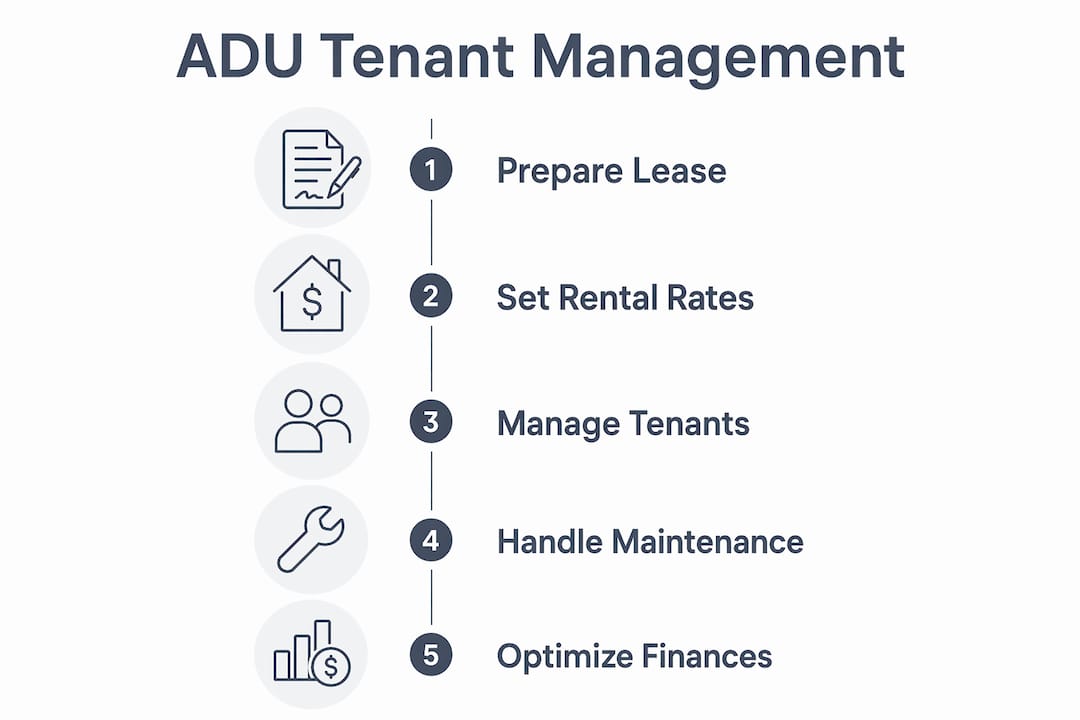
A clear process prevents the ad-hoc management that causes most build-to-rent management failures. Follow these steps in order.
-
Set staggered lease expiration dates. Never let both units expire in the same month. A 6-month offset between leases means you never face full vacancy on the property at once. This single decision reduces income risk more than any other operational choice.
-
Screen tenants using Fair Housing Act standards. Apply consistent, documented criteria: credit score thresholds, income-to-rent ratios, rental history, and background checks. The Fair Housing Act prohibits discrimination based on race, color, national origin, religion, sex, familial status, or disability. Apply the same criteria to ADU applicants as to main-house applicants.
-
Execute ADU-specific lease addenda. Address shared driveway access, trash collection schedules, parking assignments, and quiet hours. Vague lease language is the single biggest source of tenant disputes in multi-unit properties.
-
Activate your digital portal before move-in. Tenants should submit rent payments, maintenance requests, and lease documents through one platform. This creates a paper trail and removes ambiguity from every interaction.
-
Schedule coordinated maintenance windows. Give proper legal notice (typically 24 hours in most states) before entering either unit. Build a maintenance calendar that respects both tenants’ schedules. Detached ADUs increase property complexity, requiring careful maintenance access protocols to protect tenant privacy and reduce legal risk.
-
Conduct move-in and move-out inspections with photo documentation. Store all records in your digital portal. This protects you in security deposit disputes and provides evidence if a tenant damages shared infrastructure.
-
Review lease terms annually. Adjust rent to market rates at renewal. In high-demand coastal markets, a 600–800 sq ft ADU commands strong rent, and leaving money on the table at renewal compounds over years.
Pro Tip: Send a monthly digital newsletter to both tenants covering upcoming maintenance, seasonal reminders, and community updates. This builds goodwill and reduces the number of reactive calls you receive.
What challenges arise in ADU tenant management and how do you fix them?
Build-to-rent property management for ADUs produces a specific set of friction points. Knowing them in advance lets you design systems that prevent them.
Shared utility conflicts are the most common issue. When a main house and ADU share a single water or electric meter, tenants dispute who owes what. The fix is a sub-metering system installed before occupancy, or a fixed utility allocation written into each lease. Never leave utility responsibility ambiguous.
Privacy boundary violations happen when one tenant feels the other has access to their space. Clear lease language defining exclusive-use areas, shared areas, and access protocols prevents most of these conflicts. A shared driveway with no parking assignment is a dispute waiting to happen.
Maintenance scheduling conflicts arise when both tenants need repairs at the same time, or when work on shared infrastructure (roofing, plumbing) requires access to both units. Build a maintenance priority matrix: safety issues first, shared infrastructure second, unit-specific requests third.
“The most effective way to prevent double vacancy is to treat lease expiration dates as a financial instrument, not an administrative detail. Stagger them deliberately, and you protect your income floor.” — Long Beach ADU property management experts, 2026
Vacancy overlap is the most expensive problem. If both leases expire within 60 days of each other and one tenant does not renew, you face two vacant units simultaneously. The staggered lease cycle described above is the direct solution. If you inherit simultaneous expiration dates, offer one tenant a rent discount to accept a shorter renewal term that resets the offset.
Communication delays create tenant dissatisfaction faster than almost any other issue. A tenant who submits a maintenance request and hears nothing for five days is a tenant who leaves at renewal. Digital portals with automated acknowledgment messages solve this at no meaningful cost.
How do you optimize ADU management for financial performance?
Financial performance in build-to-rent ADU development depends on three levers: rental pricing, cost management, and tax structure.
Rental pricing strategy
Price each unit independently based on its features, not as a package. The ADU and main house serve different tenant profiles. A detached ADU with a private entrance commands a premium over an attached unit with shared walls. In mid-sized inland markets, the same 600–800 sq ft unit rents for $1,200 to $2,000 monthly. Know your market tier and price accordingly.
Professional management costs
Full-service ADU management typically costs 8% to 10% of monthly rent. On a $2,500 ADU rent, that is $200 to $250 per month. That fee covers pricing, marketing, tenant screening, lease execution, maintenance coordination, and financial reporting. For investors managing multiple units or living out of state, this cost is well below the value of time saved and errors avoided.
ADU type and ROI timeline
Garage conversions offer faster cost recovery, while detached ADUs provide higher rental income and property appreciation over time. The break-even timeline ranges from 6 years in urban garage conversions to 15 or more years in slower markets with high construction costs. Choose your ADU type based on your liquidity needs, not just your income goals.
Tax structure
Proper tax treatment of an ADU as a distinct rental property allows depreciation over 27.5 years. This generates paper losses that offset taxable rental income in early years. Separate bookkeeping for the ADU is not optional if you want to capture this benefit. Use dedicated accounting software or hire a CPA who specializes in rental properties.
Pro Tip: Review your ADU’s assessed value separately from the main house each year. If your county reassesses the property after construction, you may be able to appeal the ADU’s valuation and reduce your property tax base.
Key Takeaways
Effective build-to-rent ADU tenant management requires unified oversight of both units, staggered lease cycles, ADU-specific lease terms, and tax-structured accounting from the first day of operations.
| Point | Details |
|---|---|
| Unified asset management | Treat the main house and ADU as one rental business to prevent vacancy gaps and disputes. |
| Staggered lease cycles | Offset lease expiration dates by at least 6 months to protect against simultaneous vacancy. |
| ADU-specific lease terms | Include access rights, utility billing, and shared space rules in every ADU lease addendum. |
| Digital portal adoption | Use a centralized platform for rent collection, maintenance requests, and documentation. |
| Tax-structured accounting | Depreciate the ADU over 27.5 years and track expenses separately to capture full deductions. |
Why I think most ADU investors manage their properties wrong
Most investors I have seen approach ADU management the same way they approach a single-family rental: one lease, one tenant, one set of problems. That model breaks the moment you add a second unit on the same lot. The main house and ADU share infrastructure, share a landlord, and often share a driveway. Managing them as separate businesses creates gaps that tenants notice immediately.
The technology piece is where I see the biggest missed opportunity. Investors who manage by phone call and text message spend three times the hours of investors using a digital portal. They also generate zero documentation, which becomes a serious problem the first time a security deposit dispute goes to small claims court.
The other mistake I see constantly is ignoring lease coordination. Investors sign both tenants to 12-month leases starting in the same month because it feels tidy. Then one tenant leaves, and they are suddenly managing a full vacancy on a property that was generating two income streams. Staggering lease dates by six months costs nothing and protects everything.
The investors who get this right treat the property like a small apartment building, not a house with a bonus unit. That mental shift changes every decision that follows, from how they screen tenants to how they structure their taxes.
— Rudy
How Live Large™ supports your ADU rental operations
Live Large™ builds and installs accessory dwelling units designed for rental performance from the ground up. Every unit is engineered for the operational realities of build-to-rent management: clear utility separation, private entrances, and layouts that minimize shared-space friction between tenants.
Investors working with Live Large™ get more than a structure. They get a unit built to the specifications that make professional tenant management straightforward. From ADU policy compliance in markets like Tampa to full construction and installation, Live Large™ covers the development side so you can focus on operations. If you are ready to add a rental-ready ADU to your property, explore backyard ADU options and see what fits your lot and income goals.
FAQ
What is the build-to-rent ADU model?
The build-to-rent ADU model is the practice of constructing an accessory dwelling unit specifically to generate rental income, managed alongside the primary residence as a unified rental asset.
How much does professional ADU management cost?
Professional full-service ADU management costs 8% to 10% of monthly rent, covering tenant screening, lease execution, maintenance coordination, and financial reporting.
How do you prevent double vacancy in ADU rentals?
Stagger lease expiration dates by at least 6 months between the main house and ADU. This prevents simultaneous vacancy and protects your total rental income floor.
What lease terms are specific to ADU rentals?
ADU leases must include provisions for shared driveway access, utility billing responsibility, parking assignments, and maintenance entry protocols that standard residential leases do not cover.
How is an ADU depreciated for tax purposes?
The IRS allows residential rental property to be depreciated over 27.5 years. Treating the ADU as a distinct rental property generates annual paper losses that offset taxable rental income.