
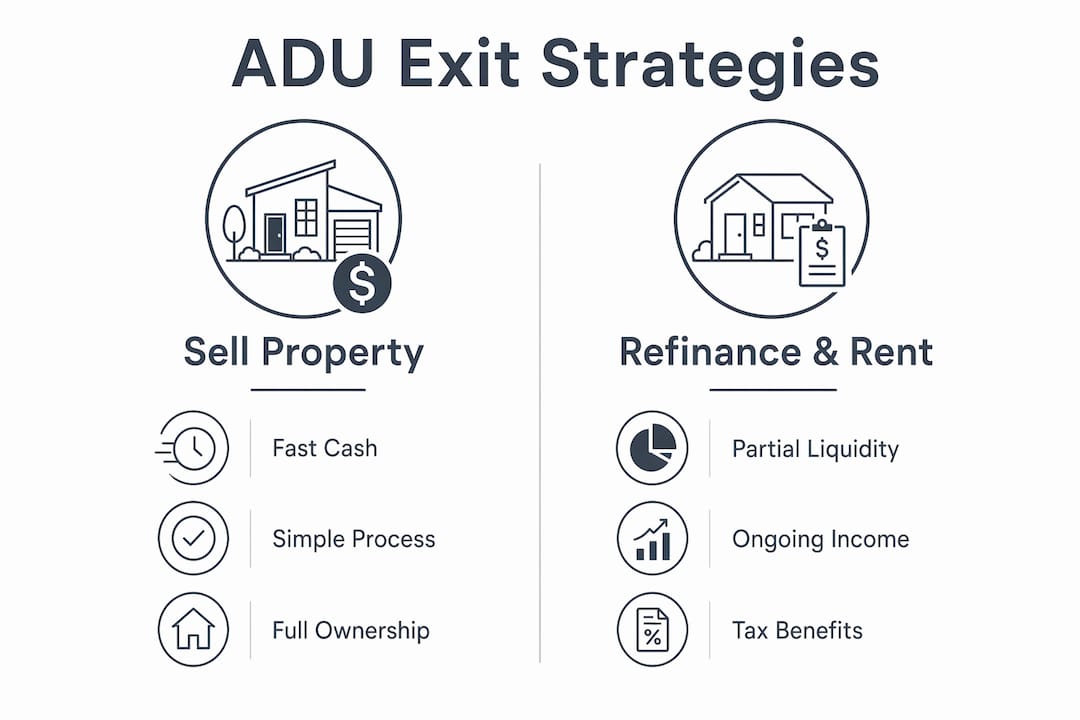
Your best ADU exit strategy depends on one question: do you need a lump sum now, or do you want income over time? Sell the whole property or subdivide for fast cash. Refinance via HELOC or fixed HELOAN for partial liquidity while keeping ownership. Rent long-term or short-term to generate ongoing cashflow. Where state law allows, such as California under AB 1033 or Washington State’s separate-title pathway, you can sell the ADU as a standalone condo unit. Investors can layer in 1031 exchanges or portfolio DSCR refinancing to defer taxes and scale. Live Large™ supports all of these paths, from design and permitting through financing assistance and property management.
Core exit options at a glance:
- Sell the whole property — fastest lump-sum, lowest complexity
- Refinance / cash-out (HELOC, home equity loan, fixed HELOAN) — partial liquidity, retain ownership
- Rent and hold (long-term or short-term) — ongoing cashflow, deferred tax via depreciation
- Subdivide / sell ADU separately — highest potential proceeds, highest complexity
- Investor moves (1031 exchange, portfolio DSCR refi, bulk sale) — tax deferral and scaling
Pro Tip: If you need cash now but want to preserve long-term upside, consider a staged approach: pull equity via a fixed HELOAN today, then plan for subdivision once your lender consents and local ordinance permits it.
Table of Contents
- What ADU exit strategy options fit your goals?
- When does selling the whole property make the most sense?
- How do HELOC, home equity loan, and fixed HELOAN compare in Q3 2026?
- Should you rent your ADU long-term or short-term?
- Can you sell your ADU separately from the main house?
- What investor moves work best for ADU portfolios?
- What legal and tax checkpoints can block your exit?
- Sample financial scenarios: sell vs. refinance vs. rent in 2026
- How Live Large™ supports your ADU exit plan
- Key Takeaways
- The exit you plan for at design time is the one you’ll actually have
- Live Large™ helps you build and exit with a plan
- Useful sources and authorities to check
What ADU exit strategy options fit your goals?
The right exit depends on four inputs: your primary goal, your timeline, your tax posture, and what your local ordinance and mortgage actually allow.
| Exit Strategy | Speed to Liquidity | Ongoing Cashflow | Complexity / Permit Risk | Tax Impact | Est. Net Proceeds After Costs | Time to Execute |
|---|---|---|---|---|---|---|
| Sell whole property | Fast (few months) | None | Low | Capital gains; primary exclusion may apply | High lump sum minus agent fees (~5–6%) | 1–3 months |
| Refinance / cash-out | Moderate (few months) | None (debt added) | Low–Medium | None at closing; interest deductible | Partial equity accessed | 1–2 months |
| Rent and hold | Slow (ongoing) | Yes — steady | Low–Medium | Passive income; depreciation shelter | Deferred; realized at future sale | 1–3 months to stabilize |
| Subdivide / sell ADU | Slow (4+ months) | None after sale | High | Capital gains on ADU portion | Highest potential, minus $8K–$25K prep costs | 4+ months |
| 1031 exchange | Moderate | Depends on replacement | High | Deferred capital gains | Reinvested, not cashed | few months |
Before committing to any path, run this checklist:
- Confirm your ADU has a valid permit and certificate of occupancy
- Review your mortgage for due-on-sale clauses and lien coverage
- Check tenant lease status (month-to-month vs. fixed-term)
- Verify whether your city has opted into AB 1033 or a state-level separate-sale pathway
- Assess your tax posture with a CPA before triggering a sale or recapture event
Pro Tip: Conflicting goals — cash now AND long-term upside — almost always resolve in favor of refinancing first. A fixed HELOAN locks your rate and preserves the asset while you wait for subdivision law or market conditions to improve.
When does selling the whole property make the most sense?
Selling the full property with a permitted ADU is the simplest path to a large, immediate payout. It requires no lender consent for subdivision, no utility separation, and no condominium mapping. If your mortgage servicer won’t consent to a lot split or your city hasn’t enabled separate ADU sales, this is often the only clean exit.
It fits best when you’re ready to move, need retirement capital, or want to exit the landlord role entirely. A permitted ADU adds measurable resale value compared with similar homes without one, and buyers increasingly price that income potential into their offers.
Key cost and timing factors:
- Agent commissions typically run a mid-single-digit percentage of sale price
- Tenant lease status matters: month-to-month tenancies give you the most scheduling flexibility; fixed-term leases can delay closing or require buyer cooperation
- Staging, repairs, and pre-listing prep add cost but typically return more than they cost in competitive markets
- Typical days-to-close is within a few months once under contract
A permitted ADU can meaningfully increase a property’s market value compared with comparable homes that lack one, particularly in supply-constrained metros where buyers value built-in rental income.
How do HELOC, home equity loan, and fixed HELOAN compare in Q3 2026?
Refinancing or pulling cash-out is the fastest way to access partial equity without giving up the asset. The choice between a HELOC, a traditional home equity loan, and a fixed HELOAN comes down to how much rate risk you’re comfortable carrying.

Q3 2026 ADU financing data shows HELOCs carrying higher variable-rate ranges, while fixed HELOANs commonly offer lower fixed rates with 10–20 year amortization terms. For ADU projects where the build cost is known upfront, a fixed HELOAN often makes more sense than a variable line.
| Product | Rate Type | Typical Amortization | Best For |
|---|---|---|---|
| HELOC | Variable | Draw period + repayment | Phased spending, flexible timing |
| Home equity loan | Fixed | 5+ years | Known lump-sum need |
| Fixed HELOAN | Fixed | 10–20 years | ADU build or refi with rate certainty |
Home equity products typically allow loan-to-value ratios that depend on the lender and borrower profile, capping how much equity you can access. For a broader look at renovation financing options beyond home equity products, partner resources can help you compare construction-to-permanent loans and FHA renovation alternatives.
Pro Tip: Use a HELOC when your spending timeline is uncertain or phased. Lock a fixed HELOAN when you know the exact amount and want rate certainty for the full term.
Should you rent your ADU long-term or short-term?
Renting keeps the asset, generates cashflow, and lets depreciation shelter taxable income. It’s the right move when subdivision isn’t currently legal in your jurisdiction, when you’re not ready to sell, or when the rental yield exceeds what you’d net from a sale after taxes and fees.
Long-term rentals offer stable occupancy and lower turnover costs. Short-term rentals (Airbnb, Vrbo) can produce higher gross rent but carry more operating overhead, platform fees, and local regulatory risk. Many cities that allow ADUs restrict or ban short-term rentals in them — check your local ordinance before assuming that option is available.
Sample net cashflow calculation (long-term rental):
- Gross monthly rent: $1,800
- Management fee (8–12%): minus $180–$216
- Maintenance reserve (5%): minus $90
- Net monthly cashflow: roughly $1,494–$1,530
Tax notes: rental income is typically classified as passive. Residential rental structures depreciate over 27.5 years, which can shelter a meaningful portion of gross income. Consult a CPA before filing — depreciation recapture at sale is a real cost that many DIY investors miss.
Operational checklist:
- Set lease terms that align with your exit timeline
- Verify local short-term rental permit requirements before listing
- Decide early whether to self-manage or hire a property manager
- Keep maintenance reserves funded to protect net yield
Can you sell your ADU separately from the main house?
In most of the U.S., you still cannot sell an ADU separately from the primary residence. Where it is possible, the mechanism runs through condominium or subdivision mapping, separate utility metering, and lender approvals. California’s AB 1033 removes the statewide prohibition and lets cities opt in; early adopters include San Jose, Berkeley, San Francisco, Oakland, and Sebastopol. Washington State has its own state-level pathway.
The five core steps for a separate sale:
- Verify your city has opted into AB 1033 or a comparable state law
- Commission a condominium map or subdivision survey
- Separate utility meters (water, gas, electric) — typically $15,000–$25,000
- Form CC&Rs and a micro-HOA if required by local ordinance
- Obtain written lienholder consent from every mortgage holder on the property
Lender consent is the most common deal-breaker. Because a mortgage lien covers the entire property, your lender may require refinancing or full loan satisfaction before a condominium map can be recorded. Due-on-sale clauses can effectively force a payoff. Total preparation costs commonly run several thousands of dollars, with timelines of several months in many metros.
Pro Tip: Talk to your mortgage servicer before spending a dollar on mapping or utility separation. A lender who won’t consent makes the entire pathway unworkable until you refinance or pay off the loan.
What investor moves work best for ADU portfolios?
Investors use 1031 exchanges to defer capital gains when swapping into like-kind property. ADUs are treated as part of the real property being exchanged, so a property with an ADU qualifies as long as it meets the held-for-investment requirement. The timing constraints are strict: 45 days to identify a replacement property, 180 days to close.
Portfolio DSCR loans underwrite to the ADU’s projected rent and typically require 20–25% down, keeping the owner’s personal income off the underwriting equation. That structure lets investors scale without encumbering their primary balance sheet. Forward-looking investors treat ADUs as strategic liquidity assets, building with subdivision potential in mind to preserve future resale optionality.
Scaling strategies worth considering:
- Build ADUs on separate lots to diversify income streams and exit timing
- Use portfolio DSCR refinancing to free capital for the next acquisition
- Bundle multiple ADUs for bulk sale to institutional or build-to-rent buyers
- Pair multifamily ADU development with a phased 1031 strategy to defer taxes across multiple cycles
What legal and tax checkpoints can block your exit?
Most exit failures trace back to items that could have been checked in week one. Run these before committing money to any path.
Legal checklist:
- Mortgage lien language and due-on-sale clauses can be significant legal obstacles
- Local ordinance status for separate ADU sales (AB 1033 opt-in or state equivalent)
- Zoning setbacks, easements, and utility rules for meter separation
- HOA or CC&R restrictions on rentals or subdivision
- Tenant protections and required notice periods in your city or state
Tax essentials: the primary-residence exclusion ($250,000 single / $500,000 married filing jointly) applies only to the portion of the property used as a primary residence. If you’ve rented the ADU, the rental portion may not qualify. Depreciation recapture is taxed at up to 25% on the depreciation previously claimed. A 1031 exchange defers but does not eliminate capital gains. Installment sales can spread the tax hit across years.
Pro Tip: Get a CPA and a real estate attorney in the same room before you sign anything. The interaction between depreciation recapture, primary-residence exclusion proration, and lender consent requirements is where most DIY exit plans fall apart.
Sample financial scenarios: sell vs. refinance vs. rent in 2026
These scenarios use consistent assumptions: ADU build cost $150,000, post-ADU property value increase $200,000, gross monthly ADU rent $1,800, management fee 10%, maintenance reserve 5%.
| Scenario | Exit Path | Gross Proceeds / Annual Cashflow | Key Costs | Net Outcome |
|---|---|---|---|---|
| Owner wants retirement cash | Sell whole property | $200,000 value uplift | mid-single-digit % agent fees; capital gains on non-excluded portion | a large net lump sum |
| Investor wants to scale | DSCR refi + hold | $1,800/month gross rent | 10% mgmt + 5% reserve = $180–$216/month | ~$1,530/month net; capital preserved |
| Homeowner hybrid approach | Fixed HELOAN + rent | Access partial equity now | HELOAN payment ~$900/month; net rent ~$1,530 | positive carry while retaining asset varies |
For a deeper look at 2026 ROI examples with Live Large™ proprietary case data, the figures above are conservative starting points.
Pro Tip: The most common DIY math error is ignoring depreciation recapture. If you claimed $20,000 in depreciation over five years and then sell, that $20,000 is taxed at up to 25% regardless of your overall capital gains rate. Run that number before you decide to sell.
How Live Large™ supports your ADU exit plan
Live Large™ provides turnkey support across the full ADU lifecycle, which cuts execution complexity and compresses time-to-exit at every stage.
Services that directly address the capability gaps in this guide:
- Design and permitting — code-compliant plans that preserve subdivision optionality (separate utility rough-ins, detached configurations)
- Financing assistance — HELOC introductions for homeowners, equity capital structures for investors
- Construction and installation — modular delivery that reduces build time and cost variance
- Property management — for owners choosing the rent-and-hold path
Planning for exit starts at design time, not after construction. Routing utilities for future separation, choosing a detached configuration, and sizing the unit for condominium conversion eligibility are decisions that cost almost nothing at the design stage and can be worth tens of thousands of dollars later. Live Large™ builds these considerations into every project from day one.
Pro Tip: Ask your Live Large™ project team to confirm that utility rough-ins are positioned for future meter separation, even if you plan to rent initially. It’s a small design decision that keeps every exit route open.
Key Takeaways
The most effective ADU exit strategy maps your liquidity goal to the right mechanism: sell for a lump sum, refinance for partial equity, rent for cashflow, or subdivide where local law allows.
| Point | Details |
|---|---|
| Match exit to goal | Sell for fast cash, refinance for partial liquidity, rent for ongoing income, subdivide for maximum proceeds. |
| Check lender consent first | Due-on-sale clauses and lien coverage can block subdivision before you spend on mapping or utility separation. |
| Subdivision costs $8K–$25K | Preparation costs and 4–9 month timelines are common in most metros; utility separation alone runs $15K–$25K. |
| Depreciation recapture is real | Rental depreciation claimed over time is taxed at up to 25% at sale — factor it into every sell-vs-hold calculation. |
| Live Large™ builds for optionality | Turnkey design, permitting, and construction from Live Large™ preserves multiple exit routes from day one. |
The exit you plan for at design time is the one you’ll actually have
Most homeowners treat the ADU exit as a future problem. Builders and experienced investors know it’s a design-time decision. The choice between attached and detached, the location of utility rough-ins, the configuration of the lot — these aren’t aesthetic preferences. They’re the variables that determine whether you can subdivide in five years or whether you’re locked into a single exit.
Lenders and local ordinances are the real gating constraints, not construction quality or market timing. A beautiful, fully rented ADU is still unsellable as a separate unit if your mortgage servicer won’t consent and your city hasn’t opted into AB 1033. That’s not a problem you solve at exit. It’s a problem you solve at design time by choosing the right configuration and having the right conversation with your lender before you break ground.
The investors who consistently extract the most value from ADUs aren’t the ones who built the nicest units. They’re the ones who built for optionality: separate utilities, detached footprints, clean permit histories, and lenders who understood the plan from the start.
Live Large™ helps you build and exit with a plan
Knowing your exit options is one thing. Executing them without costly surprises is another. Live Large™ handles design, permitting, financing assistance, construction, and property management as a single integrated service, so you’re not coordinating five separate contractors while trying to preserve your exit optionality.
A planning call with Live Large™ covers a feasibility review of your property, a rough ROI estimate across the exit paths that apply to your situation, and a clear next-step roadmap. Whether you’re a homeowner weighing sell vs. rent or an investor building a portfolio, the starting point is the same: know what your property can do before you commit to a path. Review your small home development exit options or explore the full turnkey ADU development model to see how Live Large™ structures each phase. Request a feasibility assessment at livelarge.com.
Useful sources and authorities to check
Before committing to any exit path, verify current rules with these authorities directly.
- Local city or county planning department — ask specifically: “Has your jurisdiction opted into AB 1033 or adopted a local ordinance permitting separate conveyance of ADUs?” Also confirm current setback, zoning, and utility separation requirements.
- Your mortgage servicer’s lien department — ask: “Will you consent to a condominium map or subdivision of this property, or will you require refinancing or payoff first?” Get the answer in writing before spending on mapping.
- State housing agency — California’s Department of Housing and Community Development (HCD) publishes AB 1033 opt-in status; Washington State’s Department of Commerce covers its separate-title pathway.
- IRS Publication 523 (Selling Your Home) and IRS Publication 544 (Sales and Other Dispositions of Assets) — primary sources for primary-residence exclusion rules, depreciation recapture, and 1031 exchange basics.
- A licensed CPA with real estate experience — required before any sale, subdivision, or 1031 exchange; the interaction between recapture, exclusion proration, and installment-sale elections is not DIY territory.
Key research sources cited in this article:
- AB 1033 Bay Area ADU condo guide — California separate-sale pathway and city opt-in status
- Can you sell an ADU separately? — nationwide availability overview and state comparisons
- ADU passive income guide 2026 — PERCH — Q3 2026 financing context, subdivision costs, and DSCR loan structures
- Forbes Advisor home equity rates — lender consent and lien risk detail
- Dominion Financial — ADU economics — investor strategy and portfolio optionality framing
- ADU Realtor — pre-sale preparation — tenant lease management and seller preparation
This article is general information, not legal, tax, or financial advice. Verify current rules with your local planning department, mortgage servicer, and a qualified professional before acting on any exit strategy.