
Hire professional ADU property management when you live more than 30 minutes away, own more than one rental unit, or lack time to screen tenants and handle 2 a.m. maintenance calls. Self-managing works fine for hands-on owners renting to someone they’ll interact with weekly. The reasons to bring in help come down to two things: ADUs carry legal and operational quirks that generic rental advice misses, and a bad tenant placement can cost more than a year of management fees. The sections below cover what that service actually includes, what it costs, and how to vet a manager properly.
TL;DR:
- Hiring professional ADU management is recommended if you own multiple units, live over 30 minutes away, or have frequent turnover issues that self-managing can’t efficiently handle.
- Management services include tenant screening, lease drafting with ADU-specific clauses, rent collection, maintenance coordination, and move-in/move-out inspections, often costing 8% to 12% of rent plus placement fees.
- Utility metering options—separate, sub-metered, or included—significantly impact administrative ease and dispute likelihood, with separate metering being the most straightforward long-term choice.
- Effective management begins during the design phase, with decisions on utility setup, access pathways, and shared spaces influencing rental friction and legal compliance for years.
- A simplified process involves selecting a turnkey provider for design, permitting, construction, and optional management, minimizing handoff gaps and reducing vacancy-related costs.
Table of Contents
- What Does ADU Property Management Actually Include?
- What Are Typical ADU Management Fees, and When Do They Pay For Themselves?
- What Makes ADU Management Different From Managing a Regular Rental?
- Should You Self-Manage or Hire a Professional? A Quick Checklist
- How Do You Vet an ADU Property Manager?
- How Live Large™ Supports ADU Owners Through the Whole Process
- What Insurance Do You Need Before Renting Out an ADU?
- How Should You Market an ADU Differently Than a Regular Rental?
- How Do You Handle Tenant Disputes Involving the Main House?
- What Software Helps You Manage an ADU Remotely?
- The Real Lesson: Management Is a Construction Decision, Not an Afterthought
- Get a Turnkey ADU Built and Managed Without Juggling Vendors
- Sources
What Does ADU Property Management Actually Include?
A property manager’s invoice covers real work, not a markup for doing nothing. Before you decide to hire or skip that expense, know exactly what’s on the other side of the fee.
Full-service ADU management typically bundles these tasks:
- Marketing and tenant placement: listing syndication, showings, and application screening (credit, income verification, rental history, and criminal background checks).
- Lease drafting with ADU-specific clauses: language covering shared driveways, utility responsibility, access pathways to the main house, and quiet hours near owner-occupied space.
- Rent collection and accounting: online payment processing, late-fee enforcement, and monthly owner disbursements with a statement.
- Maintenance coordination: a vendor network for plumbing, electrical, and HVAC issues, plus 24/7 emergency dispatch so a burst pipe doesn’t become your Saturday.
- Move-in and move-out inspections: documented condition reports and security deposit handling under your state’s rules.
Freddie Mac’s guidance on managing an ADU as a rental unit stresses that lease drafting and tenant screening should happen before you ever list the unit, not after you’ve already found someone eager to move in. That sequencing matters more for ADUs than standalone rentals, because a lease written for a detached single-family home rarely accounts for shared walls, shared yards, or a landlord living 20 feet away.
What Are Typical ADU Management Fees, and When Do They Pay For Themselves?
Most full-service ADU managers charge 8% to 12% of collected rent monthly, plus a separate placement fee, according to Bay Area ADU Manager’s cost breakdown. That placement fee usually runs 50% to 100% of one month’s rent, charged once when a new tenant signs.
Some managers skip the two-tier structure and charge a single, higher all-in percentage instead. Ask which model you’re getting before you sign, since the math changes depending on how often you expect turnover.
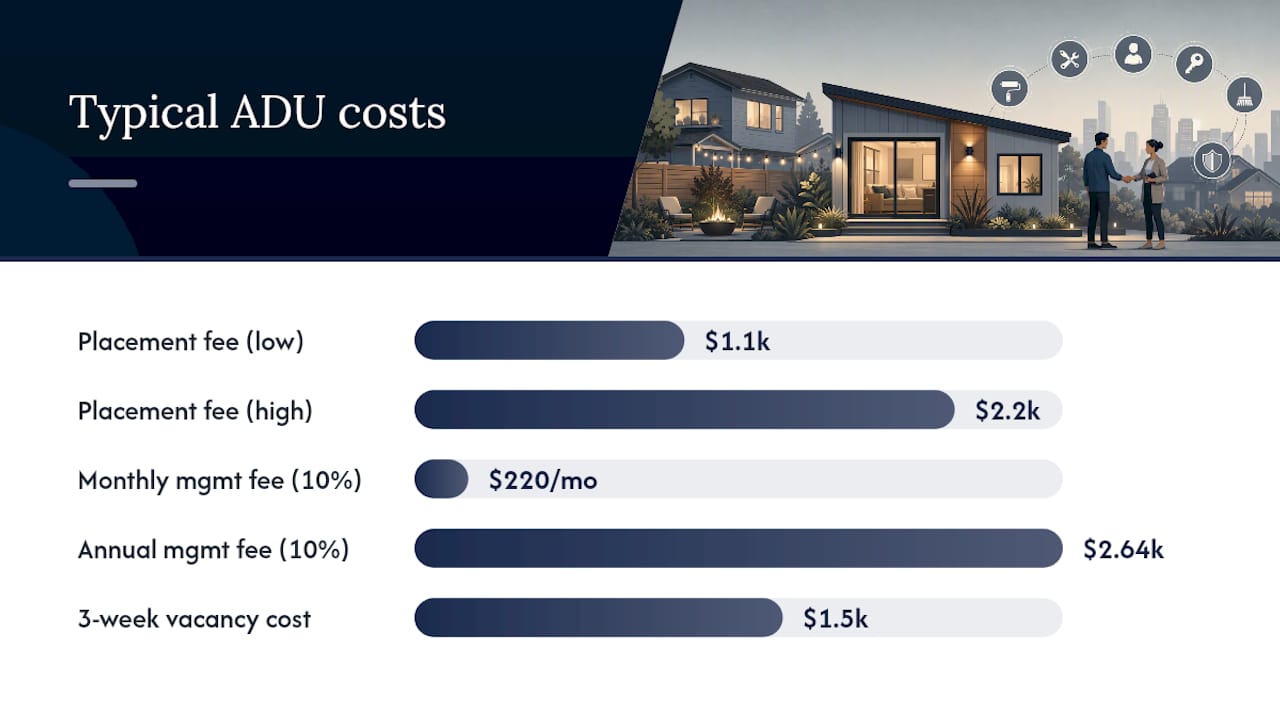
Here’s where the ROI argument gets real. Say your ADU rents for $2,200 a month. A self-managed vacancy that drags on an extra three weeks because you couldn’t screen applicants fast enough costs you roughly $1,500 in lost rent, not counting the eviction risk from rushing a bad tenant into the unit. A management fee at 10% runs about $220 a month, or $2,640 a year. One avoided bad placement or one faster turnaround often covers the entire annual fee.
Before hiring anyone, ask:
- What’s included in the base fee versus billed separately (lockout calls, lease renewals, court appearances)?
- Do vendor invoices carry a markup, and if so, how much?
- Is the placement fee refundable if the tenant breaks the lease in the first 60 days?
What Makes ADU Management Different From Managing a Regular Rental?
Standard property management advice assumes a detached unit with its own utilities and no shared anything. ADUs rarely work that way, and that gap is where most disputes start.
Utility billing is the first decision point. You have three options: separate metering, sub-metering, or folding utilities into rent. Separate metering is the cleanest long-term fix because it removes you from usage disputes entirely, though it usually means upfront cost and city sign-off before installation. Sub-metering splits an existing meter’s cost by usage, which is cheaper to set up but requires trust in the math. Including utilities in rent is simplest to administer but leaves you exposed if a tenant runs the AC nonstop in August.
Access and privacy need to be spelled out in writing, not assumed. A lease should state which pathways the tenant can use, when maintenance visits require notice, and what shared spaces (parking, laundry, yard) actually mean in practice. Vague language here is the single most common source of friction between ADU tenants and the people living in the main house, according to RPM Southland’s Long Beach ownership guide.
Treat the main house and the ADU as one property for maintenance scheduling. Bundling a roof inspection, gutter cleaning, or pest control visit across both structures saves on vendor trip fees and avoids the tenant disruption of separate visits.
- Set a written notice window (24 to 48 hours) for any non-emergency entry.
- Bundle recurring maintenance across both units when the same vendor handles both.
- Document parking, trash, and shared-yard rules in the lease, not in a verbal agreement.
Pro Tip: If you’re on the fence about metering, separate meters cost more upfront but eliminate the recurring argument over who used what. That tradeoff usually favors separate metering for anyone planning to hold the property long term.
Should You Self-Manage or Hire a Professional? A Quick Checklist
The decision usually comes down to five factors: how far you live from the property, how many units you’re juggling, how often you expect turnover, how comfortable you are with landlord-tenant law, and how much time you genuinely have each month.
Self-managing tends to work when you live on-site or nearby, own just the one ADU, and don’t mind fielding a maintenance text on a Tuesday night. Professional management earns its fee when you’re managing from a distance, holding multiple properties, or dealing with turnover more than once a year.
Score yourself on this checklist. Two or more “yes” answers point toward hiring a manager:
- Do you live more than 30 minutes from the property?
- Do you own or plan to own more than one rental unit?
- Have you had a vacancy last longer than three weeks in the past two years?
- Are you unfamiliar with your state’s security deposit and eviction laws?
- Would a 2 a.m. maintenance call genuinely ruin your week?
How Do You Vet an ADU Property Manager?
Ask specific numbers, not vague reassurances. A manager who can’t tell you their average days-to-place, current vacancy rate, or eviction rate in the last two years hasn’t tracked their own performance, which tells you something on its own.
Questions worth asking directly:
- What’s your average time from listing to signed lease?
- What’s your current vacancy rate across your ADU portfolio specifically, not just single-family homes?
- Who holds the security deposit, and how is it returned?
- Do maintenance invoices carry a markup, and what’s the percentage?
- Can I see a sample ADU-specific lease, not a generic residential template?
Watch the contract for cancellation terms that lock you in for a full year regardless of performance, vague “additional services” language that leaves room for surprise billing, and scope limits that exclude emergency response after hours. A manager with documented ADU experience, meaning they can show you an actual ADU lease template with shared-access clauses, is a stronger signal than a slick sales pitch. Walk away from anyone who can’t answer the placement-fee or vacancy-rate questions with a real number.
How Live Large™ Supports ADU Owners Through the Whole Process
Live Large™ builds the unit, then helps you avoid the handoff gaps that trip up new landlords.
- Permit navigation: guidance through local zoning and permitting before ground breaks, so occupancy limits and setback rules don’t surprise you after construction.
- Utility setup coordination: help deciding between separate metering, sub-metering, or included utilities before the unit is finished, not after a tenant moves in.
- Turnkey delivery: design, permitting, and construction handled as one contract instead of coordinating separate vendors.
- Optional management: available for owners who want the build-to-rent handoff covered without hiring a separate company.
Bundling design-build with optional management closes the gap where most owners lose money: the weeks between a finished unit and a properly screened tenant.
What Insurance Do You Need Before Renting Out an ADU?
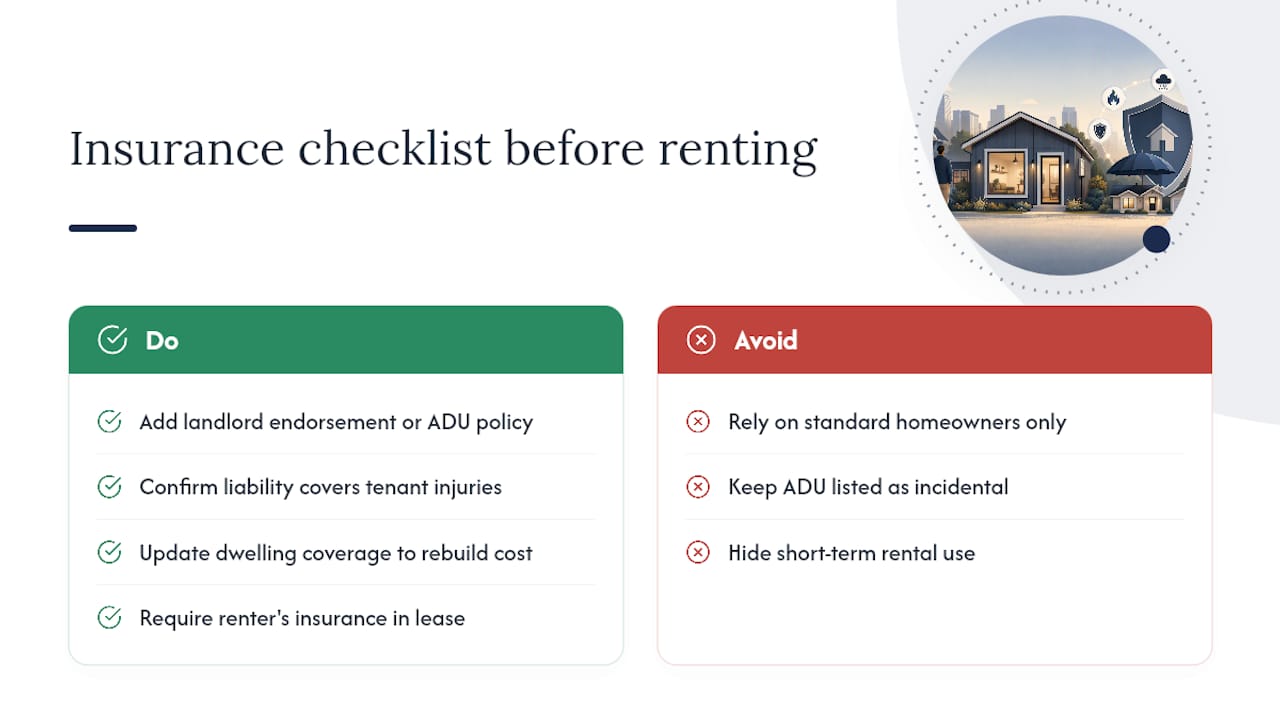
Standard homeowners insurance almost never covers a detached rental unit the same way it covers your primary residence. Renting an ADU typically requires either a landlord policy endorsement added to your existing homeowners coverage or a separate policy specifically written for the second structure.
At minimum, check that your policy covers liability for tenant injuries on the property, since a slip on a shared walkway or driveway can trigger a claim regardless of which structure the tenant occupies. Dwelling coverage for the ADU itself needs updating too. Many owners build an ADU, insure it as an incidental structure, and never realize the coverage amount is based on outdated construction costs until they file a claim.
Require your tenant to carry renter’s insurance. It’s a modest ask, usually a small monthly cost to them, and it protects their belongings while limiting disputes over who pays when something in the unit gets damaged. Put the requirement in the lease itself, not as a verbal request.
If you’re renting through a short-term platform instead of a long-term lease, tell your insurer. Short-term rental use often falls outside standard landlord policies entirely, and a claim denial after the fact is far worse than a slightly higher premium up front. Talk to an agent who has specifically written ADU or accessory-structure policies before, since not every agent has dealt with the distinction between a detached rental unit and a standard single-family rental.
How Should You Market an ADU Differently Than a Regular Rental?
Photograph the ADU’s entrance and access path separately from the main house, because the first question most applicants ask is whether they’ll feel like they’re renting someone’s backyard or a genuinely private unit. Listings that show a clear, private entry point get more serious inquiries than ones that leave that ambiguous.
Be upfront in the listing about shared elements: parking, yard access, laundry, and proximity to the primary residence. Hiding this information doesn’t get you more applicants, it gets you more no shows and awkward conversations at the showing. Renters who are fine with a shared driveway will self-select in; those who aren’t will self-select out before wasting your time.
Price using ADU-specific comparables, not generic apartment listings in the area. One-bedroom ADUs tend to hit the best balance between construction cost and rental demand, and rent ranges vary significantly by city and unit size, so pulling comps from studio apartments across town will mislead you on pricing.
List on platforms that let you filter for ADU or accessory-unit inquiries specifically when available, and mention any unique amenities (private yard space, in-unit laundry, updated finishes) prominently, since these often justify rent at the higher end of your local range. A well-lit listing with an honest description of the shared setup consistently outperforms a vague one padded with stock language.
How Do You Handle Tenant Disputes Involving the Main House?
Noise complaints are the most common friction point between ADU tenants and primary residence occupants, and most of them stem from a lease that never defined quiet hours in the first place. Set specific quiet hours in writing, typically 10 p.m. to 7 a.m., and apply them evenly. A tenant who feels singled out for noise the owner’s own household also makes will escalate faster than one operating under a rule everyone follows.
Shared-space disputes, over parking spots, trash bins, or yard access, usually trace back to the same root cause: nothing was documented at move-in. Freddie Mac’s guidance on ADU rentals recommends spelling out access pathways and shared-space expectations explicitly during onboarding, not after the first complaint arrives.
When a dispute does happen, put your response in writing and address the behavior, not the relationship. “Quiet hours are 10 p.m. to 7 a.m. per the lease” lands better than an in-person confrontation that can turn personal fast when the landlord lives 20 feet from the tenant. If a pattern continues after two written warnings, that’s the point to involve a property manager or attorney rather than letting frustration build on either side.
What Software Helps You Manage an ADU Remotely?
Rent collection software (options built for small landlords handle online payments, automatic late fees, and monthly statements) removes the awkwardness of chasing a check from someone who might also be your neighbor. Automated collection also creates a paper trail that matters if a dispute ever ends up in small claims court.
Maintenance tracking tools let tenants submit repair requests with photos, which cuts down on the back-and-forth texting that usually happens when something breaks. You get a timestamped record of when an issue was reported and when it was resolved, useful if a tenant later claims a repair was ignored.
For the numbers side, a rental property calculator that estimates cash flow, cap rate, and return on investment helps you stress test rent pricing before you commit to a number, especially useful when you’re deciding whether a $2,100 or $2,400 asking rent makes more sense given your carrying costs.
None of this software replaces the judgment calls, screening decisions, dispute handling, knowing when a maintenance request is urgent versus routine, but it removes the administrative friction that makes self-managing feel harder than it needs to be.
The Real Lesson: Management Is a Construction Decision, Not an Afterthought
Most ADU advice treats management as something you figure out after the unit is built. That’s backwards. The utility metering choice, the access pathway layout, even where you put the mailbox, all affect how much friction you’ll deal with as a landlord for years afterward. Decide those things during design, not after your first tenant complaint.
The conventional wisdom that self-managing always saves money doesn’t hold up once you count the cost of a bad placement or a three-week vacancy. Professional management isn’t insurance against every problem, but it does shift the risk of screening mistakes and legal missteps onto someone whose job is knowing the rules cold.
If you’re building new, prioritize the coordination between your builder and whoever will manage the unit long term. A design-build company that also offers optional management, like Live Large™, removes the gap where most owners lose money: the weeks between a finished structure and a properly vetted, paying tenant. Get that handoff right, and the rest of the management decision gets a lot easier.
— Rudy
Get a Turnkey ADU Built and Managed Without Juggling Vendors
You can choose a single company to cover design, permitting, construction, and delivery, with optional management available once the unit is ready to rent, instead of piecing together separate providers.
That bundling matters most in the gap this article just walked through, the weeks between a finished ADU and a properly screened, paying tenant. Rather than hiring a builder who leaves after handoff and then scrambling to find a manager familiar with ADU-specific lease clauses, consider a team familiar with the utility setup, access layout, and local permitting history due to their involvement in the build. Explore the ADU turnkey development model to see how design, construction, and optional management fit together as a single process, or check out the 4 to 12 week factory build timeline to see how fast a unit can actually go from contract to rent ready. If you’re interested, you can request a consultation to discuss timelines and options for your property.
Sources
- What ADU property management costs in the Bay Area (and when it’s worth it) — Bay Area ADU Manager
- ADU Property Management in Long Beach: Complete 2026 Owner’s Guide
- ADU Investment Guide: Costs, Rental Income & ROI (2026)